












What Are SEO, GEO, AEO and LLM SEO?
What are SEO, GEO, AEO and LLM SEO, and what are the core differences between them? We walk through the shift from traditional search engine optimisation to AI-focused visibility, the balance of context and keywords, direct-answer strategies and the steps businesses can apply.
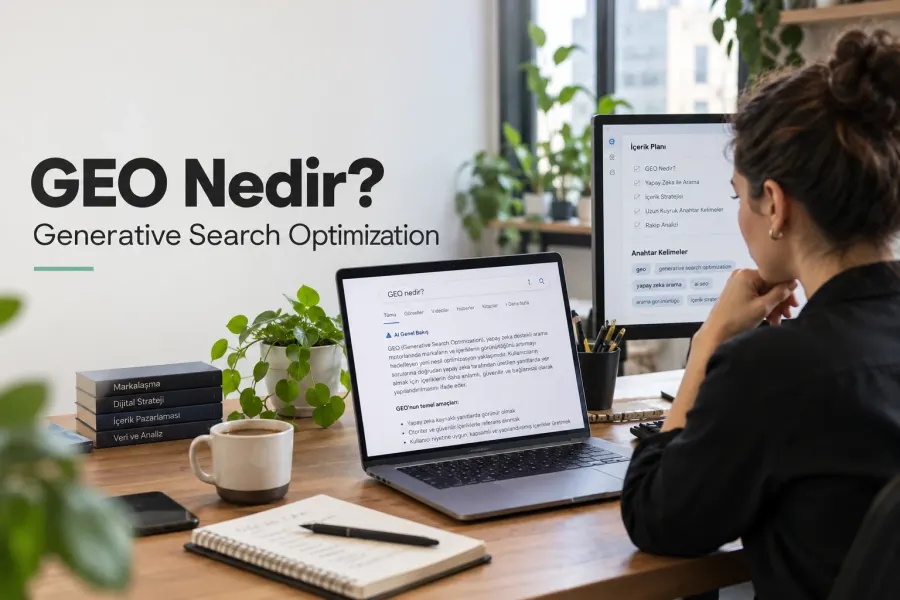
For many years, being visible online largely meant ranking high on search engines such as Google. To attract more visitors to their websites, businesses researched keywords, optimised their content, invested in technical SEO and tried to get ahead of their competitors in the search results.
But the way people look for information is changing. Many users no longer simply type a few words into a search engine and browse the links that come up. Instead, they put their questions directly to ChatGPT, Gemini, Claude, Perplexity and similar AI systems, and expect product suggestions, comparisons, explanations and solutions that fit their needs.
This shift is widening what digital visibility means.
Simply appearing in traditional search results may no longer cover every visibility need a business has. It is becoming just as important that content can be understood by AI, gives clear answers to users' questions and accurately reflects the brand's area of expertise.
Four concepts stand out here: SEO (Search Engine Optimization), GEO (Generative Engine Optimization), AEO (Answer Engine Optimization) and LLM SEO (Large Language Model SEO).
These approaches are not completely independent of each other. They share many features, yet each targets a different search and information experience.
So what exactly do SEO, GEO, AEO and LLM SEO mean? What are the core differences between them? And what kind of content strategy should a website follow to be more visible in AI-assisted search?
In this guide we look in detail at the journey from traditional search engine optimisation to AI-focused visibility, the key concepts and the methods you can put into practice.
Why Is Search Engine Optimisation Changing?
The basic purpose of an online search is to find information. The methods people prefer for finding it, however, change over time.
In a traditional search, the user usually types a short query. The search engine ranks the web pages related to that query, and the user looks through the results and picks the link that fits their need.
For example, someone who wants to buy a new desk might search Google for "wooden desk". They will see product pages, shopping sites, category listings and various recommendation articles.
They then visit different pages and compare the products.
In an AI-assisted search, the same person can phrase the question in much more detail:
"I have a small study at home. I'm looking for a desk made entirely of wood, with no metal parts, that is easy to assemble and fits in a narrow space. What should I look out for?"
This question contains more than a product name. It describes the user's living space, material preference, conditions of use, assembly expectations and reason for buying, all at once.
An AI system can weigh up this context and produce an explanation or a suggestion without being tied to a single keyword.
This difference is what drives an important transformation in digital content strategy.
It is no longer enough to look only at which words people search with; you also have to consider what the user actually needs and how clearly your content meets that need.
That said, traditional search engines have not disappeared. Platforms such as Google are building AI-assisted answer features into their own search experience.
So the new optimisation approaches do not mean abandoning SEO altogether; they mean supporting it with a broader visibility strategy.
What Is SEO? How Does Traditional Search Engine Optimisation Work?
SEO stands for Search Engine Optimization.
SEO is the combination of technical, content and structural improvements made to help search engines discover a website, understand its content and show it in relevant searches.
The main goals of SEO are to gain more visibility in search results, reach relevant visitors and increase organic search traffic.
Successful SEO, however, is not only about the number of visitors. It also matters that the people who arrive are genuinely interested in the product, service or information on offer.
Keywords Are an Important Part of Traditional SEO
Keyword research plays an important role in traditional SEO.
For example, an online shop selling yoga mats might be interested in search terms such as:
- Yoga mat
- Non-slip yoga mat
- Thick yoga mat
- Yoga mat for beginners
- Yoga mat for home workouts
- Soft yoga mat
- Pilates and yoga mat
Each of these terms represents a different user need.
"Yoga mat" is a general product search, while "yoga mat for beginners" reflects the needs of a specific group of users.
SEO work decides which pages will answer these queries. Relevant product and category pages are created, titles are arranged and explanatory content is written.
Modern SEO, however, is not just about placing keywords in certain fields. Search engines can also assess the meaning of the query, the scope of the page, the quality of the content and the value it offers the user.
The Core Components of SEO
A strong search engine optimisation strategy requires several kinds of work to be carried out together.
On-page SEO covers page titles, content, URL structures, images and internal links.
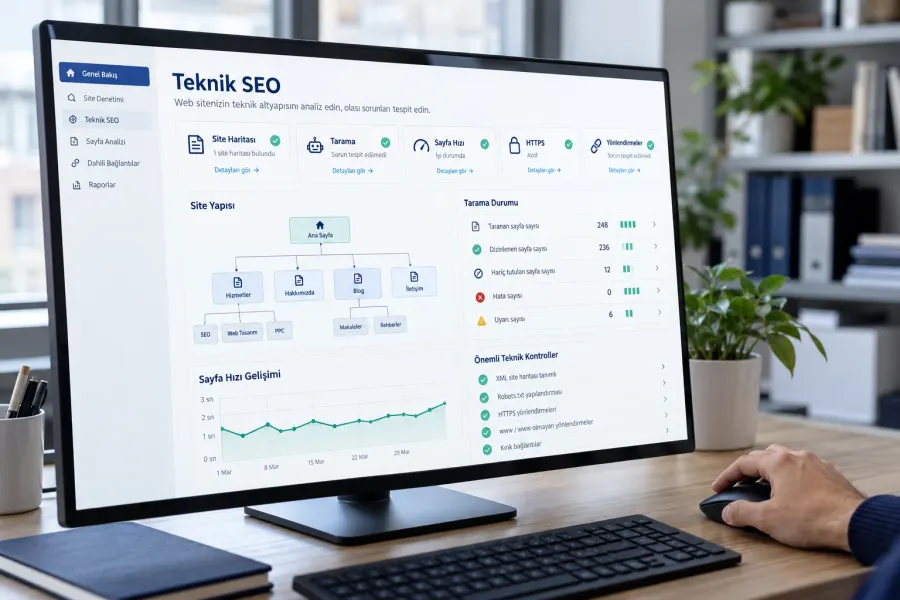
Technical SEO covers the technical adjustments that make it easier for search engines to crawl the website and process its pages. Mobile-friendliness, page performance, indexability and redirects are key topics here.
Content SEO focuses on producing explanatory, original and useful content about the topics users are searching for.
Off-page SEO covers things such as the business's reputation and recognition online and the natural links it earns from other websites.
Taken together, this work turns SEO from a technical process aimed only at search engines into a long-term strategy that improves the overall quality of the website.
What Is GEO? What Does Generative Engine Optimization Mean?
GEO stands for Generative Engine Optimization.
GEO is an optimisation approach that aims to make digital content easier for search and answer systems that use generative AI to understand, to associate with relevant topics and, where appropriate, to take into account in the answers they produce.
Traditional SEO largely targets visibility in search results, while GEO also focuses on being visible in the information and recommendation experiences generated by AI.
For example, when a user asks an AI system "How do I choose the best wooden bookcase for my home?", the system can explain the different types of material, sizes, assembly features and conditions of use.
If a business's website contains thorough information on these questions, it can help the brand and its content become a more meaningful source of information for those queries.
GEO, however, is not a method that guarantees a brand will be recommended in AI answers. The way AI systems access information, evaluate it and build answers varies from platform to platform.
So the main aim of GEO is not to guarantee a particular outcome but to improve the clarity, topical coverage, trustworthiness and digital visibility of your content.
In GEO, Context Matters More Than Keywords
One of the clearest differences between GEO and traditional SEO is the way context is handled.
Context is everything that explains under what conditions, for whom and for what purpose a piece of information applies.
Stating only a product's name and technical specifications may not explain when a user should choose that product.
For example, a yoga mat description that only says "thick yoga mat" offers limited information.
A fuller description can explain the mat's thickness, its surface, which types of exercise it is designed for, who it suits and in which situations a different product would be a better choice.
That way the content explains not only what the product is, but what it means for the user.
AI-assisted systems can draw on this kind of contextual information when answering questions.
How Should Content Be Prepared for GEO?
When writing GEO-focused content, the first step is to define the user's problem.
Then explain the solution to that problem, or the conditions in which the product is useful.
Listing only positive features is not enough. Explaining the limits and alternatives as well as the right use cases adds to the value of the information.
For example, if a product is described as suitable for children, the age range, intended use and any safety limitations should also be explained.
Likewise, when describing a digital service, state clearly who it is designed for, which problems it can solve, which features it includes and which expectations it does not meet.
This approach helps users make better-informed decisions and strengthens the coherence of the content.
What Are the Differences Between GEO and SEO?
SEO and GEO do not have to compete. Both aim to help the right users find digital content, but they focus on different forms of visibility.
In SEO, what matters is that a web page appears in the search results for a given query.
In GEO, the aim is for the content of that same page to be meaningful, relevant and usable in AI-assisted answers and recommendations.
For example, a category page built around the term "wooden bookcase" can be useful for traditional SEO.
But when an AI system is asked "What kind of wooden bookcase should I choose for a small child's room?", the category name alone may not provide enough information.
In that case it is more useful to have explanations of sizes, safety, use, assembly and materials.
The key distinction can be put like this:
SEO focuses on getting content found in relevant searches, while GEO also aims for content to be taken into account in the relevant answers and recommendations of generative AI systems.
It would be wrong, though, to think that SEO ignores context or that GEO makes keywords entirely unnecessary. Today, good content can meet the needs of both approaches at the same time.
What Is LLM SEO? How Does Large Language Model Optimisation Work?
LLM SEO comes from Large Language Model SEO. It refers to practices aimed at improving content and brand visibility in AI systems that run on large language models.
Large language models are AI models trained on large data sets that can process human language and generate text.
These models can answer questions, summarise texts, build comparisons and explain specific topics.
Systems such as ChatGPT, Claude and Gemini are examples of applications built on large language models.
The main goal of LLM SEO is to help a business's content and the information it provides become clearer and more accessible for the relevant tasks of these systems.
Are LLM SEO and GEO the Same Thing?
LLM SEO and GEO are closely related, but they can be seen as differing in scope.
GEO looks at search and answer experiences that use generative AI within a broad framework.
LLM SEO, within that framework, focuses specifically on visibility work related to large language models.
A large library is a good way to explain this relationship.
A library has different sections such as history, art, technology and science. Every section is part of the library, but each focuses on a particular subject.
In the same way, GEO represents the broad field of optimisation, while LLM SEO is the part of that field that deals with large language models.
The way these terms are used in the industry sometimes overlaps. So rather than treating the boundaries between them as fixed technical standards, it is more useful to understand their different areas of focus.
How Do Large Language Models Evaluate Content?
Large language models can process linguistic relationships and context. But not every model accesses websites in the same way, and not every model always answers using up-to-date web data.
Some systems answer only from what the model already knows, while others can use search and retrieval tools.
Because of this, a change made on a website should not be expected to have the same effect in every AI system.
Even so, clear, consistent and well-organised content helps across different ways of processing information.
For example, if a business describes its services in contradictory terms on different pages, it can create uncertainty about the brand.
A website that consistently describes its scope of services, target audience, way of working and core areas of expertise, on the other hand, gives both visitors and automated systems clearer information.
Why Does Brand Identity Matter for LLM SEO?
AI-focused visibility is not limited to optimising individual pages.
It also matters which field a brand works in, which products or services it offers and what expertise it has.
For example, a business offering corporate website design that makes do with a few general promotional sentences provides more limited information than a website that explains its services in detail.
The services a business offers, its working processes, completed projects and areas of expertise should be explained clearly.
Presenting the brand with consistent information across different digital platforms can also help strengthen its identity online.
The aim here is not to force AI systems to recommend a particular brand. The aim is to set out clearly what the brand does and which topics it may be relevant to.
What Is AEO? What Is Answer Engine Optimization For?
AEO stands for Answer Engine Optimization.
AEO aims to structure digital content so that it gives direct, clear answers to users' questions.
The approach rests on a simple need: users do not always want to see long articles or lots of links.
In some searches the user just wants the answer to a specific question.
For example:
"What is HTTPS?"
A user asking this question first expects to learn, briefly and clearly, what HTTPS means.
A thorough technical explanation can be useful afterwards. But if the content does not give a direct answer at the start, it can be harder for the user to find what they are looking for.
AEO focuses on reducing that problem.
Where Is AEO Used?
Answer engine optimisation is linked to systems that give users direct answers to their questions.
Google's featured snippets, information panels shown directly in the search results and Bing's various answer features all fall into this category.
Voice assistants are another important example of answer-focused information.
When a user asks a voice assistant "How many centimetres are there in a metre?", they usually expect a direct answer rather than a long web page being read out.
AI-assisted search systems can also count as an area where AEO applies, because they generate explanatory answers to users' questions.
There is an important distinction here, though.
Not every answer engine has to use generative AI. Some systems can draw directly on specific knowledge sources or structured data.
So AEO should not be thought of as an optimisation approach aimed only at AI systems.
How to Prepare AEO-Friendly Content
One of the most important things for AEO is answering the user's question clearly.
For example, if a blog post has the heading "What is an SSL certificate?", a direct explanation should follow immediately below it:
"An SSL certificate is a digital certificate that helps secure the communication between a website and the visitor's browser and is used to establish an encrypted connection."
After this explanation, the post can go into detail about how an SSL certificate works, when it is needed and what website owners should pay attention to.
That way the content meets the needs of both the user who wants a direct answer and the visitor looking for more detailed information.
Question-style subheadings, clear definitions, accurate classifications and short paragraphs that explain a specific point can all help in AEO-friendly content.
That said, not every paragraph has to be short and not every heading has to be a question. The natural flow and coherence of the content should be preserved.
The Key Differences Between SEO, GEO, AEO and LLM SEO
Looking at these four optimisation approaches together makes it easier to understand how digital content strategy is evolving.
| Optimisation | Main focus | Target visibility |
|---|---|---|
| SEO | Search engine optimisation | Organic search results |
| GEO | Generative AI optimisation | AI-generated search and answer experiences |
| AEO | Answer engine optimisation | Direct answers and answer-focused systems |
| LLM SEO | Large language model optimisation | AI applications that run on language models |
What these approaches have in common is that they support the creation of content that fits the user's need for information.
The difference between them lies in the systems where, and the form in which, the content is meant to be visible.
For example, a thorough technical guide can add value for SEO by appearing in the relevant search results.
The same guide answering a specific question clearly can be useful for AEO.
And the detailed explanations, examples of use and contextual information in the guide can also fit GEO and LLM SEO goals.
So businesses do not always need to create completely separate content for each of these four approaches.
What really matters is understanding how one good piece of content can be used across different search and information experiences.
Why Does Content Quality Matter in AI-Assisted Search?
Content quality plays an important role in optimisation work related to AI systems.
But quality does not simply mean writing long articles.
For content to be genuinely useful, it has to meet the user's need, give accurate information and cover the topic clearly.
For example, an article titled "How do I build a website?" that only talks about the advantages of having a website is not enough.
A user researching this topic may want to learn about choosing a domain name, hosting, content management systems, design, security, mobile-friendliness and the publishing process.
A thorough guide can help the user understand the whole process by explaining how these topics relate to each other.
In the same way, a product page should not consist only of sales phrases.
It should explain what the product does, what features it has, which users it suits and what to watch out for when using it.
This approach can help content become clearer for both search engines and AI-assisted information systems.
Topical Coherence and Semantic Relationships
The relationships in meaning between the words on a web page matter as much as the words themselves.
For example, in content about "e-commerce websites", explaining concepts such as payment infrastructure, product management, shipping integration, customer experience and security makes the coverage of the topic more complete.
But listing these concepts at random is not enough.
Each concept should be explained in terms of its relationship to the main topic.
Explain why payment infrastructure is necessary for an e-commerce site, how product management affects the business's operations and how shipping integration contributes to the order process.
That way the page stops being a text made of words and becomes a meaningful body of information.
Using Structured Data for SEO, GEO and AEO
Structured data is a markup method that describes the information on a web page in a defined format.
This data can help the search engines that support it, and other automated systems, identify certain elements of the page content more easily.
For example, on a product page the product name, price, stock status and some product features can be expressed with the appropriate structured data types.
In an article, fields such as the title, publication date and author can be defined.
Using structured data does not mean, however, that a website will definitely appear in AI answers.
Structured data is one of the methods that help present content in a technically clearer way.
It is also wrong to include information in structured data that is not on the page or does not reflect reality.
So technical markup should always match the real content of the page.
Trust and Expertise in AI SEO
A website that offers trustworthy information on specific topics has an advantage in digital visibility.
Accuracy matters especially in technical topics, financial transactions, health information and other areas that can affect users' important decisions.
Expertise does not come from a business simply calling itself an expert.
The content has to be explanatory, give accurate technical information and deal with real conditions of use.
For example, a web design business writing about mobile-friendliness should not stop at saying that mobile-friendly websites are important.
It is more useful to explain topics such as adapting to different screen sizes, readability, touch use, image sizing and page performance.
Likewise, a business offering e-commerce services can provide clear information about payment security, customer experience and product management.
Creating trustworthy content helps a brand make its knowledge of a particular subject visible.
How Should Businesses Combine SEO and AI Optimisation?
SEO, GEO, AEO and LLM SEO can be treated as parts of one strategy that complement each other.
The first requirement is that the website is technically accessible.
Next, find out what users are looking for information about and create content that meets those needs.
A basic approach a business can follow might look like this:
- Research user needs: find out which questions your target audience asks and which problems they want to solve.
- Analyse keywords: identify the search terms related to your products, services and informational content.
- Create thorough content: do not just define topics; explain them with use cases and examples.
- Give direct answers: answer specific questions without creating unnecessary uncertainty.
- Keep brand information consistent: present the business's services, areas of expertise and key details clearly.
- Improve technical SEO: improve page performance, mobile usability, crawlability and site architecture.
- Review content regularly: update information that has gone out of date and fill in missing explanations.
The effect of these steps can vary depending on the business's field, the competition, the current state of the website and the target audience.
So there is no single optimisation method or fixed order of steps that works for every business.
Is Traditional SEO No Longer Needed?
The spread of AI systems does not make traditional SEO irrelevant.
Search engines still play an important role in helping people find information, products and services online.
Some AI-assisted search systems also use search infrastructure to access content on the web.
So building a website that is technically well organised, accessible and full of good content remains important.
Concepts such as GEO, AEO and LLM SEO should not be seen as one new system that replaces SEO.
The better approach is to keep your traditional search visibility while developing content structures that adapt to changing user behaviour.
For one business organic search traffic may be what matters most, while for another, visibility in direct answers or brand awareness in AI-assisted recommendations may count for more.
A successful digital marketing strategy should be able to weigh up the areas of visibility that fit the business's goals.
The Future of SEO: From Keywords to User Intent
The development of search engine optimisation is closely tied to the way users look for information.
In the past, ranking high for certain keywords was at the centre of many SEO strategies.
Today, understanding users' search intent, answering their questions correctly and offering trustworthy information calls for a broader approach.
AI-assisted systems are an important part of this transformation.
The fact that users can describe their needs in detail instead of just typing a product name gives content creators a new perspective.
It may no longer be enough for businesses to focus only on the question "Which keyword should I rank for?"
They should also consider questions like these:
- Which problems is my target audience trying to solve?
- Which needs do my products or services meet?
- Does my website explain these needs clearly enough?
- Does my content answer users' questions directly?
- Is my brand's area of expertise presented clearly online?
The answers to these questions can help you run your SEO work as part of a more holistic strategy.
Conclusion: SEO, GEO, AEO and LLM SEO Should Be Considered Together
SEO, GEO, AEO and LLM SEO are related optimisation approaches used to understand how people find information online and to improve digital visibility across these different experiences.
SEO helps websites become visible in traditional search engines.
GEO aims to make content easier for generative AI systems to understand and to improve its chances of being considered in relevant answers.
AEO focuses on building content structures that can give direct answers to users' questions.
LLM SEO deals with content and brand visibility in systems that run on large language models in particular.
Although there are differences between these approaches, they all share the same core idea: creating clear, well-organised and trustworthy information that offers value to the user.
For businesses that want to build a strong, future-proof visibility strategy, the best approach is not just to chase rankings for certain keywords but to build a digital information structure that thoroughly meets the needs of their target audience.
Being visible in search engines matters. But answering users' questions correctly and explaining the value your brand offers clearly is becoming an increasingly important part of digital visibility.