







































How to Fix SEO Errors with AI: A Google Rich Results Guide
Learn how to find structured data errors with the Google Rich Results Test, fix schema code safely with ChatGPT, resolve Product schema problems on WordPress and Shopify, and do the work that improves your brand's chances of being recommended in AI-powered search.

Preparing quality content may not be enough on its own to succeed at search engine optimisation. A website's technical structure, its structured data markup, the user experience and whether search engines can reach the content are all important factors affecting digital visibility.
Website owners who want to use star ratings, product prices and other rich result features in Google search results in particular need to prepare their structured data code correctly.
Many business owners, however, do not have advanced technical knowledge of HTML, JSON-LD or Schema.org markup. Identifying and fixing certain SEO errors can therefore look difficult.
Today, AI tools can help with that process.
The Google Rich Results Test can be used to detect structured data problems on a page, for example. AI tools such as ChatGPT can then be used to get suggestions for correcting the faulty code.
AI-assisted SEO work is about far more than fixing code errors, though.
Google's statements about AI-powered search experiences also show that original content production, user experience, technical accessibility and a focus on the real value of visitors all matter.
The fact that AI systems now generate recommendations about businesses also shows that brand visibility has spread well beyond traditional search results.
So how do you fix SEO errors with AI? How do you use the Google Rich Results Test? Can you prepare structured data code with ChatGPT? And what work increases a business's chance of being recommended by AI-powered search systems?
In this guide we take a detailed look at everything from detecting technical SEO errors and editing code with AI to a real recommendation example and Google's own guidance for content creators.
What Is SEO Optimisation with AI?
SEO optimisation with AI means using AI tools for the analysis, content preparation, code editing and technical checks carried out to improve search engine visibility.
In this approach, AI should not be seen as a system that fully automates SEO work and guarantees success.
The more accurate approach is to use AI as an assistant that makes certain tasks easier.
A website owner may have a technical error in their structured data code, for example.
That error can be identified with the test tool Google provides.
The AI tool can then be asked what the error means, and for suggestions on how to fix the existing code.
In the same way, the heading structure of a web page can be reviewed, missing descriptions can be identified, or you can evaluate how clearly the content answers users' questions.
The output of all of this work must be checked, however.
AI systems can produce incorrect code, work from incomplete information, or suggest data that does not actually exist.
Verification, backups and controlled implementation therefore matter a great deal when using AI for technical SEO work.
What Is the Google Rich Results Test and What Does It Do?
The Google Rich Results Test is a testing tool that helps you check the structured data on your web pages against the rich search results Google supports.
With this tool you can examine whether a page is eligible for specific structured data types.
An e-commerce site may have built a product page, for example.
The page's HTML or JSON-LD code may contain Product structured data.
But if one of the required fields is missing from that markup, an eligibility problem can arise for the product rich results Google supports.
The Rich Results Test helps identify problems of this kind.
The tool is not only for e-commerce pages.
Other structured data types Google supports can also be tested under the right conditions.
Which Errors Can the Google Rich Results Test Find?
The Rich Results Test can show a range of problems related to the structured data features it supports.
These can include missing required fields, incorrectly formatted information, unsuitable values and technical errors related to specific data types.
A product page may contain Product markup but have its price or rating information defined incorrectly, for example.
On another page the format of the structured data code may be prepared incorrectly.
Some of these problems can block eligibility for the relevant rich result type.
Others may be shown as warnings related to optional features.
It should not be assumed, however, that the Rich Results Test detects every HTML, JavaScript, performance and SEO problem.
The tool is specifically for evaluating structured data aimed at the rich result features Google supports.
How Do You Use the Google Rich Results Test?
Checking a web page's structured data status through the Google Rich Results Test can take just a few basic steps.
Step 1: Decide Which Page to Check
First, choose the web page whose structured data you want to check.
A product page on an e-commerce site could be examined, for example.
That page may contain information such as product name, description, image, price and stock.
The product's own URL must be used during the check.
Testing the general homepage will not reveal structured data problems on a specific product page.
It is therefore important to identify correctly which page you want to check.
Step 2: Open the Google Rich Results Test Tool
Open Google's Rich Results Test tool and run the check either by URL or by code.
The URL test helps you examine a published web page.
The code test can be used to evaluate snippets you have prepared or edited.
This distinction is especially useful for structured data changes that have not yet been published.
After detecting faulty markup on an existing page, for example, the new code can be checked before being added to the live site.
Step 3: Test the URL
Enter the address of the web page in the URL field and start the test.
The tool examines the page it can reach and evaluates the structured data types it supports.
When the test finishes, the detected items and any errors are shown.
A Product item may have been detected on the product page, for example.
But if that item's required fields are missing, it can be evaluated as invalid.
Step 4: Review the Error Messages
If the test finds errors, open the relevant item and examine the details.
A Product markup may show an error stating that at least one suitable field out of offers, review or aggregateRating must be specified, for example.
That error means at least one of the required pieces of information for the product rich result is missing.
There is an important point here, though.
An error message mentioning the rating field does not mean a rating must be added to the product.
If the product has a genuine sales offer, suitable Offer information can be used.
If there are no real customer reviews, fake scores or comments must never be created.
Step 5: Examine the Code Containing the Error
In some cases the Google Rich Results Test shows the section of code the detected error relates to.
Product markup may define the product name, image, description and brand information, for example.
But the appropriate fields for the sales offer may be missing.
In that case, examining the code section containing the error reveals which information needs to be completed.
People with code-editing experience can do this manually.
Users with limited technical knowledge can get help from AI tools.
A Real Example: A Product Schema Error
In a training exercise on structured data checks, the product page of a website built directly in HTML is examined.
The page owner had prepared the structured data code earlier but suspects it may be faulty.
They therefore enter the page's URL into the Google Rich Results Test tool and run the check.
The test detects one invalid item.
On inspection, Product markup is present, but some of the fields required for the product rich result are missing.
The error relates to the offers, review and aggregateRating fields.
The page owner's existing code contains information such as product name, image, description and brand.
But suitable offer or rating information is missing.
The product structured data is therefore not considered eligible for the intended rich result feature.
This example illustrates a problem that comes up often in structured data work:
Code being present on the page does not mean the code is complete for the Google rich result you are targeting.
What is more, the problem does not always stem from a complex software bug.
Sometimes completing one missing field with the right information is all it takes.
How Do You Fix a Structured Data Error with ChatGPT?
Once you have detected the structured data problem, the second stage is correcting the existing code.
This can be done manually.
Users with limited HTML or JSON-LD knowledge, however, can get support from AI tools such as ChatGPT.
The error message shown by the Google Rich Results Test and the relevant code section can be passed to the AI, for example.
You can then ask why the error occurred and how it can be fixed.
The advantage of this approach is not only getting new code, but also learning what the error means and understanding the steps to resolve it.
What Information Should You Give the AI?
To get a sound suggestion from an AI tool, the problem has to be described clearly.
Instead of simply saying "fix my SEO code", state the data type containing the error and the message Google displayed.
For an error related to Product markup, a request like this can be prepared:
"I checked the Product structured data on my website with the Google Rich Results Test. The tool says that a suitable field out of offers, review or aggregateRating is missing. Review my existing code and explain the cause of the error. Do not add reviews, ratings or product information that does not actually exist. Preserve my current HTML structure, suggest only the necessary corrections, and prepare the updated code."
This request expresses far more clearly what you want the AI to do.
It also sets a boundary that helps prevent incorrect or invented information being added.
Do You Need to Give the AI the Entire HTML File?
Sending the page's complete HTML code to the AI is not necessary in every case.
If the problem relates only to a specific JSON-LD block, examining that section first is usually more appropriate.
In some cases the structured data may be placed across different parts of the page.
A more comprehensive review of the HTML structure may then be needed.
Before sharing any code, however, personal information, private API keys, access tokens and other sensitive data must be removed.
A web page's source code can contain information that should never be shared for security reasons.
Sending an entire file to a third-party system without checking it is therefore the wrong approach.
AI should only be used with the code sections that are necessary and appropriate to share.
How Do You Prepare Corrected Schema Code with AI?
To resolve a structured data error, first establish whether the missing information actually exists.
If the product page does contain price and stock information, that information can be defined with suitable Product and Offer markup.
But if the product has no real price, an example price generated by the AI must never be used on the live page.
Example: Product JSON-LD Markup
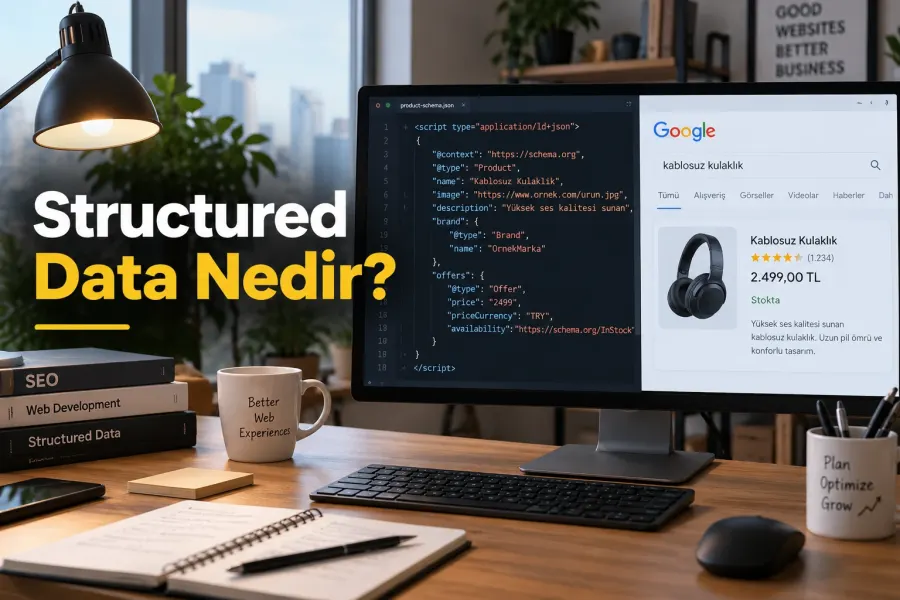
The following example is a hypothetical JSON-LD markup prepared to show how product data can be structured.
<script type="application/ld+json"> { "@context": "https://schema.org", "@type": "Product", "name": "Wooden Desk Organiser", "description": "A wooden desk organiser designed to keep small items tidy on your desk.", "image": "https://www.example.com/product.jpg", "offers": { "@type": "Offer", "price": "499.00", "priceCurrency": "TRY", "availability": "https://schema.org/InStock", "url": "https://www.example.com/product" } } </script>In this example the Product type is used to define the product information.
The name field holds the product name.
The description field contains the product description.
The image field defines the product image.
The offers section holds the information about the sales offer.
Price, currency, stock status and the product link are specified in their respective fields.
This code should never be copied straight to a real website, however.
The product name, image address, price, stock status and product link must all be replaced with real information.
The 499 TRY price used here in particular is only an example.
Should the AI Fill In the Missing Fields Itself?
No.
AI can explain which fields are missing and suggest a suitable code structure.
The real product information, though, must be supplied by the user or by the relevant data system.
When Google shows that a rating field is missing, for example, you should never ask ChatGPT to create a fake five-star review.
If there are no genuine user reviews, that information should not be added.
In the same way, using InStock when the product is actually out of stock would be misleading.
In the process of editing code with AI, the accuracy of the data matters just as much as technical validity.
Is Code Prepared by AI Trustworthy?
AI systems can help with different code formats such as HTML, CSS, JavaScript and JSON-LD.
There is no guarantee, however, that the code produced is always correct, secure or compatible with your existing website.
When you ask for an entire HTML page to be rebuilt in particular, some sections can be left out.
The existing design can break.
Forms, links or JavaScript functions can be changed by accident.
Making the most limited, most controlled edit possible is therefore the safer way to fix a structured data error.
Back Up Before Changing Code
The first thing to do is back up the existing code.
If you are working on an HTML file, keep a copy of the original, for example.
If you use WordPress, preserve the current state of the site with a suitable backup method.
If you are going to change theme files on Shopify, prepare an appropriate copy of the theme.
That way you can return to the previous version if something unexpected goes wrong after the edit.
Change Only the Relevant Code
A missing field in Product markup does not require the page's entire HTML code to be changed.
Fix the relevant structured data section first.
You can ask the AI to explain which lines of the existing code it changed.
This method makes the changes far easier to check.
Compare the Code Before and After
The code prepared by the AI should be compared with the original.
Check whether there are any unexpected changes.
Product information, links, page design and functional areas in particular should all be reviewed.
Correct syntax alone does not mean the edit is entirely safe.
Test the Code Again
Enter the edited structured data into the Google Rich Results Test again.
Check whether the previous error has been resolved.
Make further edits if necessary.
A successful test result does not mean the rich search result will definitely be shown in Google, however.
The test helps evaluate technical eligibility.
Google decides whether rich results actually appear on the search screen.
How Do You Fix Schema Errors on WordPress and Shopify Sites?
In content management systems such as WordPress and Shopify, structured data is sometimes generated automatically.
That means not every user has to prepare JSON-LD code manually.
It should not be assumed, though, that automatic markup is always complete or error-free.
The theme, plugins and other apps in use can all affect the structured data output.
WordPress Schema Errors
On WordPress sites, some SEO plugins generate structured data for articles, pages or specific content types.
Plugins such as Yoast SEO can provide various schema markup on suitable pages, for example.
To evaluate whether the existing markup is correct, though, the page has to be tested.
When an error is detected, first establish which plugin or theme component generated the code.
The relevant settings can then be examined.
If the necessary change can be made through the plugin, there may be no need to edit theme files directly.
Shopify Product Schema Errors
On Shopify sites, product markup can be generated by the theme in use or by related apps.
That markup can contain information such as product name, price, image, brand and stock.
Some products, however, can suffer from missing data or markup mismatches.
A product's variant prices not matching the price in the structured data can cause problems, for example.
In the same way, it is wrong for structured data to show old information when stock status has changed.
Testing Shopify product pages against specific examples is therefore useful.
Another important point is making sure the same Product markup is not generated in conflicting ways by the theme and by apps.
In every case, identify the source of the problem first, then choose the appropriate fix.
Is Fixing Code Enough for Visibility in Google Search Results?
Fixing structured data errors can be an important part of technical SEO work.
But that alone is not enough to improve a website's visibility in search results.
Google emphasises the importance of content that is genuinely valuable to users in AI-powered search experiences too.
This brings the fundamental purpose of search engine optimisation back into focus.
A website working properly from a technical point of view matters.
But if the visitor cannot find the information they are looking for, or the content is not genuinely useful, correct markup alone will not make up for it.
In AI SEO work, technical fixes and content quality therefore have to be developed together.
Google's Recommended Approach for Succeeding in AI Search
Official statements shared by John Mueller of the Google Search Relations team cover some fundamental SEO principles that also apply to AI-powered search experiences.
In discussing systems such as Google AI Overviews and AI Mode, those statements do not argue for a move to a completely different understanding of SEO.
Instead the emphasis is on preparing original, useful content for users, offering a good page experience and preserving technical accessibility.
This shows that AI SEO work should improve genuine content quality rather than simply trying to look right for new tools.
1. Prepare Original, Valuable Content for Users
One of the key themes in Google's statements about AI search experiences is producing content that genuinely meets users' needs.
In this approach, preparing a large number of articles that merely contain certain keywords is not enough.
Content must offer original explanations, useful information and the detail that answers users' questions.
There may be a great many pages on the internet explaining "what is SEO?", for example.
But content that explains how SEO is actually implemented for a specific industry, addresses real problems and offers applicable methods delivers far more value to the reader.
The aim here is not simply to phrase sentences differently.
The content has to be genuinely useful in terms of information.
What Does Original Content Actually Mean?
Original content is a broader concept than restating what other pages say in different words.
Content can create original value by offering real experience of the topic or new explanations.
Someone working in web design can describe the common problems they have run into on real projects, for example.
An e-commerce business can address the product questions customers ask most often.
A furniture maker can explain how material choices affect both production and everyday use.
Information of this kind goes beyond general definitions and gives the reader far more detail.
It is important that original views are supported by accurate information, however.
Unrealistic or unverifiable claims should never be made simply to look different.
Is AI-Generated Content Harmful for SEO?
Using AI to prepare content does not by itself mean the content is low quality.
What matters is whether the resulting text is accurate, useful and suited to the user's needs.
AI tools can help with topic planning, heading suggestions, improving descriptions and editing text.
Producing large volumes of content that holds no value for the user, that is highly repetitive or that contains incorrect information does create problems, though.
Publishing dozens of articles on the same topic with only the headings changed builds no real depth of information, for example.
In the same way, publishing AI-written text without any review can lead to incorrect technical information or unverifiable claims.
Human review and genuine expertise therefore matter a great deal in AI-assisted content production.
Why Does Google Care About a Good Page Experience?
Preparing quality content matters, but users also need to be able to reach that content comfortably.
If a page loads very slowly, does not display properly on mobile devices, or important information gets lost among a mass of distracting elements, the visitor experience suffers.
Page experience therefore keeps its importance in AI-powered search just as in traditional SEO work.
Mobile Compatibility
A website must work properly at different screen sizes.
Text needs to be readable, links need to be usable, and images need to be placed appropriately for the screen size.
A user reaching the website from a mobile device should never be forced to use the desktop view.
Page Performance
Oversized images, inefficient code and server problems can all hurt page performance.
A website's technical performance should therefore be reviewed regularly.
Reaching a particular speed score alone does not guarantee top positions in search results, however.
Performance optimisation is a broader effort that improves the user experience.
Making Content Easy to Find
Users need to reach the key information they are looking for easily on a web page.
Understanding a product price or a service scope should not require reading long, irrelevant explanations.
Headings, paragraphs and page sections should be arranged in a logical order.
This approach supports both the user experience and how understandable the content is.
Why Does It Matter That Google Can Reach Your Content?
Technical accessibility features prominently in Google's recommendations about AI search experiences.
A web page may offer excellent content.
But if Googlebot cannot reach that page, Google's ability to evaluate the content is limited.
Search engines therefore need to be able to reach your important pages.
Check for robots.txt Blocks
The robots.txt file can be used to direct the access of supporting crawler bots to certain URL paths.
Incorrectly written rules, however, can block important pages from being crawled.
General crawl blocks used during development may have been left in place on the live website, for example.
In that case the relevant bots cannot reach the pages' content.
Check HTTP Status Codes
It is important that a web page responds correctly from the server.
A page that is normally accessible is expected to return a successful HTTP response, for example.
Server errors or incorrect redirects can affect crawling.
The technical status of important pages should therefore be reviewed.
Evaluate Indexability
A page being crawlable is not the same as it being added to the Google index.
Website owners can evaluate the indexing status of their important pages through Google Search Console.
A page being indexed does not guarantee top positions for particular searches either.
Crawling, indexing and ranking are separate processes.
Structured Data and Visible Content Must Match
Google's recommendations also include making sure structured data matches the content actually on the page.
This matters especially for e-commerce sites.
Showing a different price in the structured data for a product listed at 799 TRY on the product page would be wrong, for example.
In the same way, adding customer reviews that do not appear on the page to the schema code is misleading.
Structured data should therefore not only be technically valid.
It must also represent accurate information.
Valid Code Does Not Always Mean Accurate Data
A JSON-LD block may have perfectly correct syntax.
But if the information inside it is not real, the data quality problem remains.
Product markup prepared by an AI tool may pass the technical test, for example.
If the stated price does not match the real product price, though, the code should not be considered a correct implementation.
Two separate checks are therefore needed in structured data work.
The first is the technical validity of the code.
The second is the accuracy of the data and its consistency with the content shown on the page.
Both checks need to be carried out together.
Why Do Images and Videos Matter for AI SEO?
Google's statements also draw attention to the importance of image and video content alongside text.
This relates to the developments described as multimodal search.
In multimodal search experiences, users are not limited to typing text.
They can upload an image, ask a question about a photo, or combine different content formats.
It is therefore useful for the visual content on a website to be high quality and relevant to the topic.
A furniture product page can include images of the product shot from different angles, for example.
Explanatory assembly images can be prepared for a product that requires assembly.
For a software service, images showing the application screens or explainer videos can be used.
These elements do not only make the page look more appealing.
They can also help users understand products and services better.
How Do You Support Image SEO?
Organising images with meaningful file names and supporting them with suitable alternative text is useful.
The key features of a solid wood desk organiser can be expressed correctly in that product image's alt text, for example.
Filling alternative text with nothing but keywords is the wrong approach, however.
Alt text should describe the content and context of the image.
It is also important that images are served at appropriate sizes and do not needlessly harm page performance.
Can Traffic from AI-Powered Search Results Be More Valuable?
One notable theme in Google's statements about AI-powered search experiences is the assessment of how valuable the visitors from search results are.
Google states that users who move through to websites from result pages containing AI Overviews can show longer engagement.
In that assessment, the fact that AI-generated answers can give users more context about a topic is treated as an important factor.
A user may have researched different options with the help of AI before buying a particular service, for example.
When that user then moves to the relevant business's website, they may already have a certain amount of background knowledge about the service.
Under some conditions that can make the visitor more engaged.
It should not be assumed, though, that every visitor arriving from an AI search will necessarily stay on the site longer or make a purchase.
Is the Organic Traffic Count Enough on Its Own?
Earning organic traffic can be important for a website.
But visitor numbers alone do not demonstrate a business's digital marketing success.
A website may attract a large number of visitors each month, for example.
If most of those people are not interested in the services on offer, the commercial value of that traffic remains limited.
Another website may receive fewer visitors but reach a far more relevant audience.
Some of those users may request a quote, buy a product or fill in a contact form.
In SEO performance, therefore, attention should go not only to traffic volume but also to the meaningful actions visitors take.
Which Data Should Measure AI SEO Success?
When evaluating visibility in AI-powered search systems, it is useful to examine several measurements together.
Those measurements need to relate to the business's field of activity.
Sales and orders may matter most for an e-commerce site, for example.
For a business offering corporate services, quote requests or contact forms may be more meaningful.
For a website publishing informational content, users' engagement with that content can be evaluated.
Visitor Numbers
The number of visitors reaching the website in specific periods can be tracked.
This data helps you understand general traffic trends.
A change in visitor numbers alone may not explain a change in AI visibility, however.
Conversion Rate
A conversion is the user completing an action that is meaningful for the business.
That action could be buying a product, filling in a quote form or applying for a particular service.
Conversion rate helps you evaluate the proportion of users who complete that action.
Visitor Engagement
The actions users take within the website can be examined.
Movement from a particular service page to the contact page can be evaluated, for example.
When interpreting engagement data, though, the purpose of the page must be taken into account.
On a page that answers a short question, the user may find what they need immediately and leave.
That does not always mean a poor user experience.
Brand Searches
Changes in searches carried out with a business's brand name can also be examined.
Rising interest in the brand can reflect the effect of different marketing work.
Looking only at an increase in brand searches, however, cannot establish with certainty that it stems from AI recommendations.
Visibility in AI Answers
Questions related to the business's field of activity can be tested across different AI systems.
You can examine which topics the brand is associated with and whether the information given is accurate.
A single AI answer is not a permanent or general ranking indicator, though.
Results should therefore be evaluated across different queries and time periods.
A Real Example: An Instructor Recommended by AI
To understand the potential of LLM SEO work, we can examine a real recommendation generated by AI.
Alex Genadinik, who creates online courses, discusses an AI answer shared by a student taking his SEO course.
The student asked an AI system to recommend online courses with certain characteristics.
The question specifically expressed a preference for courses offered by American instructors.
Fields such as AI, SEO and cybersecurity were also included in the scope of the research.
The AI-generated answer offered course recommendations related to the preferences the student had stated.
In the screenshot shared, the first instructor recommended is Alex Genadinik.
In explaining why the recommendation fits, the system refers to the instructor's experience and teaching style.
This example shows that a person can be recommended by AI even in a user question that does not search for their brand name directly.
Which Optimisation Work Had the Instructor Done?
In the example shared, the instructor describes some of the work he had carried out to improve his own digital visibility.
That includes explaining his personal expertise and teaching background.
He also promotes the courses he has created on his own website.
He prepares question-and-answer content about specific courses.
He develops information describing his own experience and areas of expertise.
What this work has in common is that the instructor explains his own identity and the courses he offers far more comprehensively, rather than simply publishing course titles.
The AI system's answer contains explanations related to exactly those characteristics.
It would be wrong, however, to draw a definite cause-and-effect conclusion from this.
Does This Example Prove LLM SEO Definitely Works?
No. This example shows the AI answer one particular user received under particular conditions.
A screenshot does not prove that the SEO changes made were the sole cause of the recommendation.
What is more, the same query asked by another user could produce different recommendations.
The version of the AI model used, the information it can reach and the context of the question can all change the results.
That said, the example does reveal an important possibility for businesses.
Even when a brand's name is not searched for directly, it is possible for it to appear in an AI answer when it is judged to fit the user's need.
It is therefore useful for businesses to focus not only on brand-name searches but also on broader user questions about the services they offer.
How Can a Business Become Visible in AI Recommendations?
A business that wants to be recommended by AI systems first needs to build its own digital identity accurately and comprehensively.
A web design company using only the statement "we offer professional web design services" provides very limited information, for example.
Instead, the company can explain which types of websites it builds, which businesses it serves and how its working process unfolds.
The business's genuine areas of expertise and experience can also be conveyed accurately.
Imagine a user asking an AI, "which companies offer suitable website services for newly founded small businesses?"
To be relevant to a query like that, it helps if the business genuinely offers services suited to small businesses and explains them clearly.
Simply adding a particular sentence to the website does not mean the AI will definitely recommend the business, though.
Define Your Brand Identity Clearly
The field the business operates in must be described clearly.
Core areas of expertise can appear on the about page.
The work on offer can be explained in detail on the service pages.
Real experience and verifiable projects can be shared on suitable pages.
This approach helps users understand the business better.
Answer Users' Questions
Research which questions your target audience asks.
Explanatory content can be prepared for those questions.
A web design company can address the common decisions small businesses face when commissioning a website, for example.
It can explain which needs each package suits.
Real service terms must be used in the content.
Share Topic-Specific Experience
The experience a business has gained from real projects can make its content far more useful.
How a particular website performance problem was solved can be described, for example.
An integration problem encountered in an e-commerce project can be explained.
Fictional case studies and unverifiable success rates must never be used, however.
Present Consistent Information Across Digital Channels
Core information must be consistent on the business's website, its professional profiles and the other digital spaces it manages.
If the field of activity or the scope of services has changed, the relevant descriptions must be updated.
This approach helps reduce confusion about the brand.
How Do You Check Visibility in AI Recommendations?
To understand how a business is represented across different AI systems, you can prepare specific test questions.
Those tests should not be carried out with the brand name alone, however.
For a web design company, question types like these can be evaluated:
- Which website design services are suitable for small businesses?
- What features should you look for when commissioning a corporate website?
- How should you compare companies that build e-commerce sites?
- Which conditions matter when choosing a professional web design service?
- What should a business looking for a mobile-friendly corporate website look for?
These questions represent different user needs.
In these tests, what the answer is based on and whether it is accurate matter just as much as whether the brand name appears.
It should not be assumed that all AI systems show their sources in the same way, though.
Some tools can search the live web while others draw on different information sources.
Test results should therefore not be treated as a definitive ranking list.
The Most Common Mistakes in AI SEO Work
Some of the mistakes that can occur in AI-assisted SEO work can make technical problems worse or create the wrong expectations.
Publishing Code Without Testing It
Adding code prepared by ChatGPT straight to a live website can be risky.
The code may not be compatible with the existing setup.
Technical changes should therefore always be tested.
Needlessly Replacing the Entire HTML File
Changing a whole HTML page when only one schema field is missing creates unnecessary risk.
Making the most limited edit possible is safer.
Using Product Information That Is Not Real
AI can fill missing fields with example data.
Using example prices, ratings or stock information on a live website is misleading, however.
All information must be verified against real data.
Measuring SEO Performance by Traffic Alone
Traffic is an important measurement but not sufficient on its own.
The meaningful actions visitors take and the commercial results should also be evaluated.
Producing Endless Similar Articles Instead of Original Content
Publishing many similar texts about the same topic does not automatically improve content quality.
Each article needs to meet a different or more detailed user need.
Treating One AI Answer as a Definitive Result
An AI system recommending a particular brand once does not mean the brand will be recommended the same way for every user.
Visibility reviews should therefore be carried out across different queries and periods.
An AI SEO Improvement Checklist
Businesses that want to evaluate technical SEO and AI visibility work together can use the checklist below.
| Check area | What to do |
|---|---|
| Structured data | Check the existing markup |
| Rich Results Test | Review the errors and warnings |
| Product schema | Verify real price, product and offer information |
| Code editing with AI | Fix the required fields in a controlled way |
| Backup | Keep the current version before changing code |
| Retesting | Check the technical validity of the edited code |
| Original content | Offer the user real informational value |
| Page experience | Evaluate mobile usability, navigation and performance |
| Accessibility | Examine Googlebot and indexing problems |
| Images | Use relevant, explanatory visuals |
| Brand information | Keep about and service descriptions current |
| AI visibility | Examine how the brand is represented across different user questions |
| SEO performance | Evaluate traffic, conversions and related engagement |
These checks can be prioritised according to the website's structure and needs.
Product structured data errors may be the priority on an e-commerce site, for example.
For another business offering corporate services, inadequate service descriptions may be the more important problem.
Rather than applying the same steps in the same order to every website, the existing problems need to be identified first.
How Long Does AI SEO Work Take to Produce Results?
There is no definite timeframe for AI SEO work that applies to every website.
Fixing a structured data error can remove the technical problem.
When Google will recrawl the page, or which features it will show in search results, is not certain, however.
In the same way, when content updates will be evaluated by AI-powered search systems depends on various conditions.
Some systems can reach current web information.
Others generate answers for certain tasks from information acquired earlier.
You should therefore not expect every AI tool to use the same new information immediately after a web page is updated.
Fixing technical code errors and building long-term brand reputation are not the same process either.
A code error can be fixed with one specific edit, while developing trustworthy content and brand awareness requires sustained work.
The Future of SEO in Google's New Search Experiences
As AI-powered search systems develop, the way users look for information can change too.
Users now research not only with short keywords but with far more detailed questions.
Instead of searching for a product's name, they can ask under which conditions it is suitable.
Instead of finding one service provider's link, they may want to compare different services.
This shift can create new visibility opportunities for website owners.
It does not mean traditional SEO work should be abandoned entirely, though.
Search engines being able to discover pages, websites working properly from a technical standpoint and content providing accurate information all keep their importance.
Content approaches developed for AI systems should be built on that same foundation.
Originality, user experience, technical accessibility and content quality — the themes that stand out in Google's statements — have in fact been important parts of successful SEO work for a long time.
What has changed is that this information is now evaluated by users inside different search experiences.
Rather than targeting the behaviour of one specific AI application, preparing accurate and useful information that can be understood across different systems is therefore a more sustainable approach.
Conclusion: Fixing SEO Errors with AI and Improving Visibility
AI tools are among the significant aids available for making technical SEO work easier.
They can be particularly useful for tasks such as explaining structured data errors, identifying missing schema fields and preparing suitable code corrections.
The Google Rich Results Test is one of the important tools for the technical check stage of that process.
Once a structured data problem on a web page has been detected, the relevant code can be evaluated with the help of AI.
The accuracy of the code produced must always be checked, the existing files must be backed up, and the changes must be tested, however.
Alongside that, Google's statements about AI search experiences show that SEO work does not consist of technical code alone.
Preparing original, useful content for users, offering a good page experience, making sure search engines can reach your content and keeping the information on your website accurate all keep their importance.
Real-world examples showing that AI systems can recommend businesses even without a brand-name search reveal that digital visibility has spread across far more areas.
Individual recommendation examples do not prove that a particular optimisation method will produce the same result for every business, though.
Realistic goals therefore need to be set in SEO work.
Technical problems must be checked, the information users need must be explained, brand identity must be presented accurately, and performance must be evaluated through meaningful results rather than visitor numbers alone.
Successful SEO work with AI rests not on using the technology without oversight, but on detecting technical errors correctly, preparing trustworthy information, improving the user experience and verifying every change before applying it.
This approach can help you develop a far more solid digital visibility strategy in both traditional Google search results and AI-powered search experiences.