







Do Google AI Overviews Reduce Organic Traffic? AI Search and SEO
Are Google AI Overviews cutting the organic traffic that reaches websites by answering questions directly in the search results? We examine Sundar Pichai's statements, the impact of zero-click searches, the opportunities Google AI Mode opens up and how AI shopping agents could reshape e-commerce.
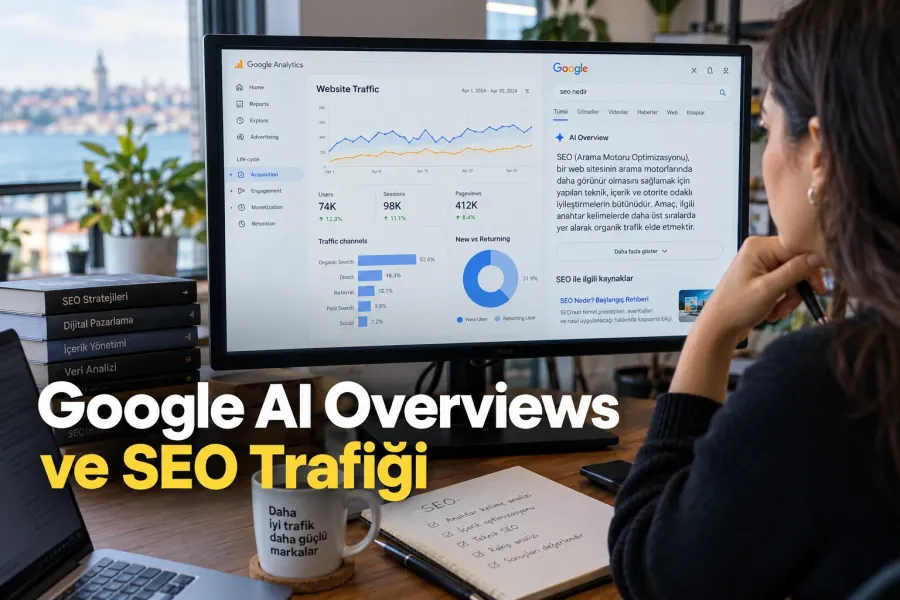
Do Google AI Overviews Reduce Website Traffic? The Impact of AI Search on SEO
For many years Google has operated as one of the most important platforms people use to reach information. Billions of search queries send users to different websites, product pages, news sources and businesses. Thanks to this structure, a large number of companies, publishers and content creators have been able to grow by making use of organic search traffic.
With the rise of AI-powered search features, however, the future of that relationship has started to be questioned.
Google AI Overviews in particular has drawn the attention of website owners, because it generates answers to user questions directly inside the search results.
In the traditional search experience, a user usually had to click through to a website in order to reach the information they were looking for. In an AI-powered search experience, the user can learn the answer to their question without ever moving to another website.
That raises an important question:
As Google provides more answers with artificial intelligence, are websites losing their opportunity to earn organic traffic?
Google CEO Sundar Pichai responded to this criticism in an interview, arguing that AI-powered search experiences can contribute to the web ecosystem.
According to Pichai, AI Overviews has the potential to send traffic to a wider group of websites. New search features such as Google AI Mode are also intended to keep connecting users with different internet sources.
For a significant share of website owners, though, the core problem remains the same: if the user can find the answer they need on Google, why would they visit the website at all?
This question does not only concern bloggers or news sites. E-commerce businesses, service providers, ad-supported publishers and digital marketing specialists can all be affected by the shift.
In this guide we take a detailed look at the relationship between Google AI Overviews and organic traffic, Sundar Pichai's statements, the effects of zero-click searches, how AI agents could change e-commerce, and how businesses can prepare for the new search experience.
What Are Google AI Overviews and Why Can They Affect Organic Traffic?
Google AI Overviews is a feature that presents AI-generated explanations directly inside Google search results for certain queries.
Depending on the user's question, these explanations can include short answers, comparisons, recommendations and links to related sources.
For example, when a user searches for "what is an SSL certificate?", Google may show an AI summary that explains the concept.
If the user learns the basic answer from that summary, they may not feel the need to click through to another web page.
In the traditional search experience, the same user would usually have opened an article from the search results to get that information.
This difference is an important development that can change how organic traffic is generated.
How Does Traffic Form in the Traditional Search Experience?
In a traditional Google search, the user creates a query.
Google shows the relevant web pages in the search results.
The user reviews the results and clicks the link that looks most suitable.
They then read information on that website, examine products or complete some other action.
This process offers meaningful opportunities for website owners.
The visitor can read the article in question.
They can discover other pages on the site.
They can take an interest in the services the business offers.
They can subscribe to an email newsletter of their own accord, or buy a product.
Organic traffic is therefore not only a transfer of information. It is also a channel that creates a direct relationship between the user and the business.
What Changes in AI-Powered Search?
In an AI-powered search experience, part of the process of gathering information can happen directly on Google.
The user may not have to move to another page in order to learn the main answer they were looking for.
This matters most for short queries that can be answered directly.
For example, if a user is only looking for the answer to "what is a 301 redirect?", an AI summary may be enough.
But if that same user is researching "how do I fix broken 301 redirects on my WordPress site?", they may need a detailed implementation guide.
AI Overviews therefore does not affect every search query in the same way.
The intent behind the search, the user's information needs and the complexity of the task all matter.
Is Google Reducing Website Traffic?
One of the most important debates around Google's AI-powered search features is that website owners' content is used while visitors stay on Google's own platform.
Some publishers and businesses are concerned that this could reduce the organic traffic reaching their websites.
At the heart of this criticism lies a relationship between search engines and content creators that has lasted for many years.
Website owners prepare content.
Google discovers that content and shows it in the search results.
Users click the relevant results and visit the websites.
Users reach information while website owners gain visitors.
When the search engine uses that content to generate a direct answer, however, this relationship can start working in a different way.
Why Are Content Creators Concerned?
Preparing a comprehensive article on a website takes time and effort.
Technical topics in particular may require research, fact-checking, image preparation and regular updates to the content.
All of that work carries a certain cost.
A content creator may aim to earn organic traffic from the article they have prepared.
But if the user learns the information they need directly from Google AI Overviews, they may never visit the website.
This can matter a great deal for publishers who depend on advertising revenue.
For a website that earns money through ad impressions or ad interactions, a drop in visitor numbers has direct commercial consequences.
It is worth remembering, though, that not every website has the same revenue model.
For an e-commerce business or a corporate service provider, gaining fewer but more purchase-ready visitors can produce a very different outcome.
How Did Google CEO Sundar Pichai Respond to These Criticisms?
Google CEO Sundar Pichai addressed questions about the effect of AI Overviews and AI-powered search experiences on the traffic sent to websites during an interview.
The view that stood out in his remarks is that Google still wants to connect users with different internet sources.
The argument is that Google's AI summaries can send visitors to a wider group of websites, and that this approach will continue with AI Mode.
That claim is particularly interesting for small and medium-sized businesses.
In many industries, large brands hold a powerful competitive advantage in traditional search results.
If AI-powered search experiences give room to a greater variety of sources, this could create new visibility opportunities for some smaller websites.
But the possibility becoming reality does not mean that every small business will automatically gain more traffic.
What Does Sending Traffic to More Websites Mean?
Google saying that it sends visitors to a wider group of websites is not the same as saying that every website gains more visitors.
In a given industry, large websites may be earning less traffic than before while a portion of smaller sites gain more visibility.
In that scenario the distribution of traffic has become more varied.
The total number of clicks, however, may be moving in a different direction.
When evaluating claims about traffic growth, it therefore matters a great deal which data is being compared.
These distinctions in particular should be taken into account:
- Is total referral traffic from Google increasing?
- Is traffic being spread across a larger number of websites?
- Is the click count of one specific website increasing?
- Is the click-through rate on search results changing?
- Are fewer visitors producing more sales or more customer enquiries?
These questions measure different outcomes.
A broad statement about traffic growth therefore does not by itself prove that the organic traffic of every publisher or business has risen.
Are Google's Statements a Guarantee of Traffic?
No.
Sundar Pichai's remarks reflect Google's position that AI-powered search can contribute to the web ecosystem.
That view does not promise a traffic increase for every website.
Results in specific industries can be very different.
News content, short reference pages, product comparisons and corporate service pages do not share the same search behaviour.
The effect of AI Overviews therefore has to be assessed separately for each website's revenue model and for the search intent of its users.
What Are Zero-Click Searches?
A zero-click search is one where the user gets the information they need on the search results page and completes their search without moving to another website.
This behaviour did not appear with AI systems.
Google has been able to provide direct answers for certain queries for a long time.
Weather, simple arithmetic and unit conversions, for example, can all be shown inside the search results.
With AI Overviews, however, the range of queries that can be answered directly may widen.
AI-generated summaries can now be produced for some topics that previously required reviewing several different web pages.
This makes evaluating zero-click searches from an SEO perspective more important than ever.
How Do Zero-Click Searches Affect Organic Traffic?
If the main purpose of a website is to provide short pieces of information, users learning those answers directly on Google can limit visitor acquisition.
Consider a page targeting the question "what is HTTP 404?".
If the user only wants to learn what the error code means, a short explanation may be enough.
But if the user is researching "I keep getting 404 errors on my WordPress site, how can I fix it?", they may need far more detail.
In an SEO strategy it is therefore important to cover not only short definition queries but also topics that require the user to take action or to gather more comprehensive information.
Is Every Zero-Click Search a Loss for Businesses?
The answer depends on the business's revenue model.
For a website that relies on advertising revenue, losing visitors can translate directly into lost income.
For a business selling a specific service, the situation can be different.
If a user is only looking for an answer to "what is SEO?", they may not yet intend to buy an SEO service.
A user asking "which criteria should I consider when buying professional SEO services for my corporate website?" is likely to have a far more concrete need.
That second user may well want to visit websites in order to find the right service provider.
The possibility that information-seeking users become customers in the future should not be ignored either.
If a business focuses only on visitors close to the purchase stage, it reduces its chance to build a relationship with people encountering the brand for the first time.
The impact of zero-click searches should therefore be evaluated in terms of both short-term conversions and long-term brand awareness.
Which Matters More in Organic Traffic: Quantity or Quality?
As AI-powered search systems become more widespread, traffic quality is becoming one of the more widely discussed topics.
Traditional SEO performance is often measured by visitor numbers.
But gaining a large number of visitors does not always mean generating a proportional amount of sales, customer enquiries or revenue.
Imagine a website that receives 20,000 organic visitors a month.
Only a small share of those visitors may be interested in the services on offer.
Another website receiving 5,000 organic visitors a month may reach more genuinely relevant prospects.
In that case the second website creates higher commercial value with fewer visitors.
What Does Higher-Quality Traffic Mean?
Quality traffic is about whether the people visiting a website engage meaningfully with the content, products or services on offer.
For a business offering website design services, for example, visitors who review service packages and request a quote are what matter.
On an e-commerce site, users who compare product features and complete a purchase create commercial value.
Traffic quality is not measured by sales alone for every business, though.
For an informational website, users finding the content useful and returning when they need it again can be just as important.
The concept of quality traffic therefore has to be evaluated alongside the purpose of the website.
Can AI Bring Higher-Quality Visitors?
AI-powered search systems can help users complete part of their research inside the search results.
A user might, for example, use AI to work out which website infrastructure suits their needs.
By the time they visit a particular service provider's website, they may understand their own requirements far better.
That can lead some visitors to make more informed decisions.
It cannot be said, however, that every visitor arriving via AI necessarily converts at a higher rate.
The real effect has to be assessed using the business's own traffic and conversion data.
Is Google AI Mode a New Opportunity for Organic Traffic?
Google AI Mode is a search experience where users can ask broader questions and continue researching the same topic with follow-up questions.
While AI Overviews provides summary answers for certain Google searches, AI Mode focuses on more interactive research processes.
This approach is part of a wider shift from a search engine that simply ranks links towards a more comprehensive research assistant.
A user might, for example, be planning to launch a new e-commerce site.
They could start by asking which platforms are suitable.
They might then research details about payment systems and product management.
In the final stage they may want to learn which features a particular service provider offers.
Different kinds of information matter at each stage of that process.
Does Google AI Mode Provide Source Links?
Google AI Mode can provide links to the web sources related to the answers it generates.
Users can then move to those websites to examine the details.
Links to web sources also feature prominently in Sundar Pichai's remarks.
The stated aim is that Google does not limit users to its own answers but keeps connecting them with different internet sources.
Showing a source link does not mean the user will necessarily click it, however.
The user may find the answer sufficient.
They may ask another question.
They may choose a different source.
A website being cited as a source and that website gaining a visitor are therefore two separate outcomes.
Can AI Search Systems Give Small Businesses an Advantage?
In many industries, large and well-established brands enjoy strong visibility in traditional Google search results.
That makes competition difficult for small businesses.
A newly launched website in particular can find itself up against large competitors with vast amounts of content and links.
In AI-powered search experiences, the fact that user questions are more detailed can create new opportunities for businesses operating in specific areas of expertise.
A large furniture retailer may dominate generic desk searches, for example.
But a small manufacturer offering products made from one specific material, built to custom dimensions or designed for particular use cases may be a better match for more specific searches.
One of the most important opportunities for small businesses is therefore to describe the products or services they offer clearly.
Why Do Niche Areas of Expertise Matter?
Niche expertise means focusing on a specific product, service or customer need.
A company producing furniture in general and a business making only solid wood, flat-pack furniture offer measurably different products.
That distinction becomes important when a user specifically searches for a product containing no metal parts.
It is not acceptable, however, for a business to claim features it does not actually offer purely in order to appear in AI results.
Product descriptions must reflect genuine material and manufacturing information.
In the same way, a web design company that specialises in services for particular industries can explain that expertise.
This approach helps users evaluate which businesses genuinely fit their needs.
Can Small Sites Outrank Big Brands?
For some queries a small website can provide more relevant and more explanatory information.
It cannot be said, though, that AI-powered search systems automatically place every small site ahead of large brands.
Visibility depends on how the system evaluates the content and on the nature of the query.
The goal for small businesses should therefore not simply be to look different from their larger competitors.
Preparing accurate, comprehensive and trustworthy information in the areas where they genuinely deliver good service is a far more solid approach.
How Can AI Agents Change E-Commerce?
Another topic covered in Sundar Pichai's interview was the possible impact of AI agents on shopping and other digital transactions.
AI agents are software systems that can plan in order to carry out specific tasks and use the appropriate tools to do so.
This approach can allow users to go beyond simply searching for information and complete some tasks with the help of AI.
A user might, for example, want to buy a product with specific features.
An AI agent could research and compare different options through supported systems.
Where the necessary permissions and technical capabilities exist, it could also help carry out certain steps of the transaction.
It should not be assumed, however, that every AI agent can shop automatically from every e-commerce site.
Transactions of this kind depend on platform support, technical integrations and user permissions.
How Does the Traditional E-Commerce Process Work?
In the traditional e-commerce experience, the user usually searches for a product.
They visit different stores.
They compare product descriptions, images and prices.
They then move to the page of the product they have chosen and complete the purchase.
Throughout this process the user interacts directly with the store's digital environment.
They see the business's brand name.
They browse the range of products.
They may discover campaigns.
They learn the purchase terms.
If interested, they may also consider other products.
All of this helps the business build a relationship with the customer.
What Can Change When an AI Agent Shops?
As AI agents become more active in the shopping process, the direct interaction between the customer and e-commerce sites can change.
A user might explain their needs to an AI tool.
The system could compare products across different stores.
It could identify suitable options based on the user's preferences.
Where supported, it could also assist with some steps of the purchase.
In that case the user may not visit every store that was researched.
This is where one of the significant problems for businesses appears.
If an AI agent researches products and the user never visits the store, the brand loses its opportunity to be recognised directly.
That risk particularly concerns businesses that develop customer relationships through their own website.
Can AI Agents Reduce Brand Awareness?
A direct website visit is not always necessary for a business to build a relationship with a customer.
In the traditional e-commerce experience, however, the store's design, product presentation, tone of voice and customer service all contribute to how the brand is perceived.
In transactions carried out through AI, some of those touchpoints can change.
A user might compare products from five different stores with the help of AI.
But they may never open any of those stores' websites.
In the end, interaction may be limited to the seller of the product that was chosen.
If no purchase happens at all, the user may never even learn which brands were considered.
This creates new challenges for businesses in terms of brand visibility and customer relationships.
Why Does Building a Direct Customer Relationship Matter?
The success of an e-commerce business may not depend on the first sale alone.
Repeat purchases, customer satisfaction and brand loyalty matter too.
A customer who buys a solid wood desk may later be interested in the same store's bookcases or shelving.
But in shopping experiences where the customer never really got to know the brand, developing that relationship becomes much harder.
Businesses therefore need to care not only about their products being found by AI systems, but also about their brands being introduced clearly.
Product quality, after-sales support and customer experience can all be decisive in this process.
Can AI Agents Affect Cross-Selling and Upselling?
E-commerce sites usually present customers with other relevant products during the purchase process.
A user buying a desk might be shown a desk organiser or a bookcase, for example.
This approach is known as cross-selling.
Upselling, meanwhile, encourages the user to consider a more comprehensive product or one with different features.
As AI agents take a larger role in shopping, how these methods are applied can change.
How Can Product Recommendations Change?
On a traditional e-commerce site, product recommendations can be displayed in the store's own interface.
In shopping conducted through AI, recommendations depend on how the system evaluates the user's needs.
If the user only wants a bookcase with specific features, the AI system may not recommend unrelated add-on products.
From the user's point of view that can mean a more focused shopping experience.
But it can also limit the business's opportunity to introduce its other products.
That said, it cannot be claimed that AI agents will eliminate cross-selling opportunities in every case.
Relevant product recommendations can still be presented in different ways, depending on technical integrations and how the system works.
How Should E-Commerce Sites Prepare for the AI Era?
For businesses that want to prepare for AI-assisted shopping systems, the quality of product information is an important starting point.
Product name, price, stock, material and dimensions must all be prepared accurately.
The features that allow a user to choose between similar products in particular should be explained clearly.
It is also worth explaining which user need a product is suitable for.
If a bookcase is made entirely of solid wood, for example, the material structure should be stated correctly.
If assembly is required, that information should be clear.
If a product has specific safety requirements, they should not be hidden.
This approach is useful both for users shopping directly and for automated systems comparing products.
Important Information on E-Commerce Sites
| Information field | Why it matters to the user |
|---|---|
| Product name | Correct identification of the product being searched for |
| Material | Understanding what the product is made from |
| Dimensions | Assessing whether it fits the intended space |
| Price | Comparing cost against the alternatives |
| Stock | Knowing whether the product can actually be bought |
| Assembly | Understanding the setup requirements |
| Delivery | Planning the order process |
| Return terms | Evaluating the risks of the purchase |
| Warranty and support | Understanding after-sales conditions |
Not all of these fields are equally important for every product type.
The core features that influence the purchase decision, however, should always be presented clearly.
How Can AI Overviews Affect Ad-Supported Websites?
Websites that run on advertising revenue can be affected more directly by changes in organic traffic.
An informational blog, for example, may earn income from the ads displayed on the pages its visitors read.
When users start learning the basic information from that blog through Google AI Overviews instead, visitor numbers can fall.
That in turn affects ad impressions and the revenue tied to them.
The size of the effect varies with the site's content type and with user behaviour.
What Will Happen to Informational Content?
Short definitions and basic explanations are among the queries AI systems can answer directly.
It should not be assumed, however, that all informational content will lose its value.
Detailed technical guides, genuine implementation experience, original research and specific comparisons can all give users a reason to visit the source page directly.
A short answer may be enough for "what is WordPress?", for example.
But solving a particular WordPress error may require a comprehensive guide with screenshots, code examples and actionable steps.
Content creators can therefore develop content that solves users' real problems, rather than pages that only provide definitions.
Is Writing Long Articles the Solution?
No.
An article being long does not mean it necessarily offers the user more value.
Repeating the same information or adding unnecessary explanation does not improve content quality.
What matters is answering the question correctly.
If the topic is complex, a comprehensive explanation may be required.
If the topic is simple, a short and clear answer may be more appropriate.
Content strategy should therefore not focus on word count alone.
What Should SEO Strategy Look Like After Google AI Overviews?
Businesses that want to adapt to AI-powered search experiences do not need to change their SEO strategies completely.
Developing existing work in line with users' new search habits, however, can be very useful.
A few key areas stand out in this process.
1. Research the Questions Users Actually Ask
Instead of focusing only on short keywords, research which questions users ask during their decision-making process.
The keyword "corporate website" represents a general topic, for example.
The question "is a five-page website enough for a newly founded business?" expresses a far more specific need.
Explanatory content can be prepared for questions of that kind.
2. Improve Pre-Purchase Research Content
Before buying a product or service, a user may want to compare different options.
The advantages, limitations and use cases of products should therefore be explained clearly.
A business offering website design services could explain the differences between a single-page website and a multi-page corporate website, for example.
That makes it easier for the user to identify the option that fits their own needs.
3. Share Real Experience and Original Information
Genuine insight a business has gained from its own work can give content a distinctive value.
You can explain how a particular technical problem was solved.
Real project processes can be described.
The problems customers run into most often can be addressed.
Unverified success rates or experiences that never happened should never be presented as real, however.
4. Strengthen Brand Identity
The website should state clearly what the business does.
The about page should be kept up to date.
Service descriptions should reflect the real scope of the work.
It is important that the business's core information is consistent across its different digital channels.
This approach helps the brand be understood more easily both by users and by automated information-processing systems.
5. Keep Technical SEO Work Going
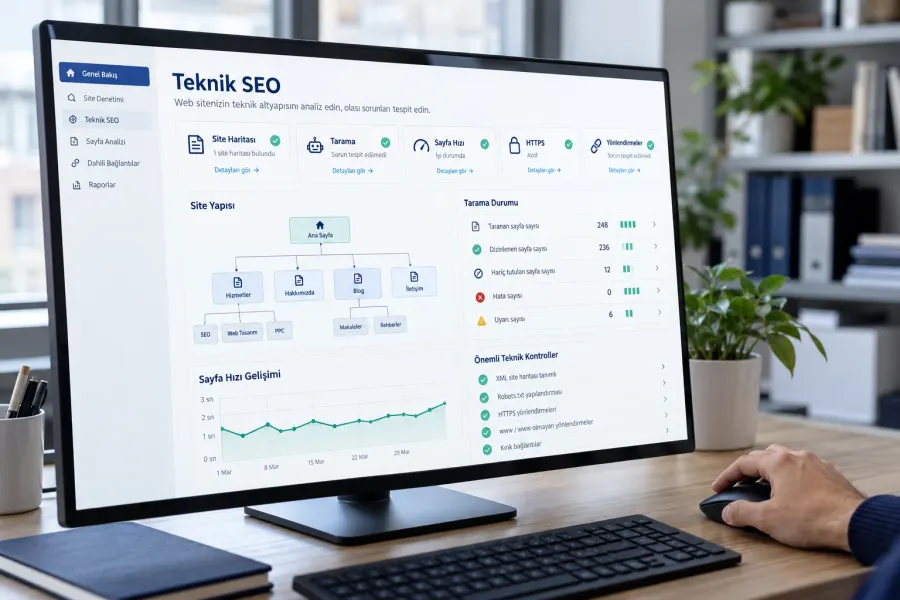
AI-powered search features do not remove the importance of technical SEO.
Important pages need to be accessible.
There should be no incorrect crawl blocks in the robots.txt file.
Internal links should work properly.
Mobile usability and page performance should be evaluated.
This work matters both for user experience and for search engines being able to process the website.
6. Keep Content and Product Information Current
The information on a website can change over time.
Product prices, stock levels, service scopes and technical specifications may all be updated.
Important pages should therefore be reviewed regularly.
Information that can help AI systems support a user's decision in particular must be prepared accurately.
7. Do Not Measure SEO Success by Traffic Alone
Visitor numbers are an important performance indicator.
Depending on the business's goals, however, conversions, sales, quote requests and brand awareness should also be evaluated.
That makes it possible to see whether less traffic is still producing higher commercial value.
How Is Google AI Overviews Traffic Measured?
Observing the search results is not enough to evaluate the effect of AI Overviews correctly.
The website's own performance data must be examined as well.
Google Search Console and suitable web analytics tools can be used in this process.
Traffic from some AI-powered search features may not always be presented as a separate and complete report category, however.
The limits of the measurement should therefore be kept in mind.
Review Google Search Console Data
Organic search performance can be evaluated through Google Search Console.
Impressions, clicks, queries and page performance can all be reviewed.
If a particular article's impressions are rising while its clicks fall, for example, that is worth noting.
It cannot be said with certainty that the change was caused by AI Overviews alone, though.
Competition in the search results, user behaviour and other factors can all play a part.
Evaluate Click-Through Rate
Click-through rate expresses the proportion of clicks relative to impressions.
If a page receives many impressions in a given period but fewer clicks, user behaviour in the search results may have changed.
Click-through rate alone is not enough, however.
Ranking changes and query types should also be evaluated.
Track Conversions
For a service provider, contact requests and quote enquiries may be what matters.
For an e-commerce site, sales and orders may be more decisive.
Ad-supported publishers, meanwhile, can track page views and advertising revenue.
The business's revenue model should therefore be taken into account when assessing the effect of AI Overviews.
Review Brand Searches
How often a business is searched for directly by brand name can also be evaluated.
It should not be automatically assumed, however, that changes in brand searches are caused by AI visibility.
Ad campaigns, social media activity and other marketing work all affect brand awareness too.
Example: How Can a Web Design Company Prepare for AI Search?
Consider a business offering corporate website design, e-commerce development and SEO services.
Alongside being visible in traditional Google searches, the company also wants to be presented appropriately in AI-powered search experiences.
For a business like this, the first step may be to assess what information its current website actually provides.
Detailing Service Pages
The scope of the corporate website design service can be explained.
It can state which kinds of businesses it suits.
The features included in each package, and any limitations, can be described.
The website then becomes useful not only to people searching for the service by name, but also to users trying to decide which service to choose.
Creating Comparison Content
The business can prepare content explaining the differences between its service types.
For example:
"A single-page website or a five-page corporate website?"
Content like this can explain the conditions under which each option is suitable.
The features that influence the user's decision can be compared.
Other options should never be unfairly portrayed in a negative light in order to sell one specific package, however.
Presenting Real Project Experience
The company can describe the problems it encountered in suitable projects and the solutions it applied.
Real work on mobile compatibility or performance improvement could be covered, for example.
This kind of information sets out the business's area of expertise far more clearly.
Keeping Brand Information Consistent
The descriptions on the about page should be consistent with the service pages.
Old services, or services no longer offered, should be updated.
Contact details must be accurate.
This helps both users and information-gathering systems find more consistent information about the business.
Example: How Can a Solid Wood Furniture Maker Prepare for AI-Assisted Shopping?
As another example, consider a business that manufactures furniture entirely from solid wood.
Let us say the business sells bookcases, tables and shelving.
Assume the products contain no metal parts and that certain models ship flat-packed.
If those features match the real products, it is important that they are explained clearly on the product pages.
Users may not simply ask an AI system for a "wooden bookcase".
They may well create detailed queries like this:
"I am looking for a wooden bookcase with no metal fixings, easy to assemble, that will work in a small room."
For a product to be evaluated against that question, the product description needs to include information about material, joinery method, dimensions and usage conditions.
Completing Missing Product Information
First, the material structure of the product should be explained.
Its real dimensions should then be stated.
The assembly method should be described.
It should be clear which parts are included in the package.
If there are safety conditions to observe during use, those should be stated too.
The user can then make a far more informed judgement about whether the product fits their needs.
Introducing the Brand Along With the Product
In a shopping experience where AI agents compare products, the user may not visit every store.
It is therefore important that the real brand is presented correctly in the product information.
Repeating the brand name unnecessarily throughout the descriptions is not the right approach, however.
The core brand and manufacturer information related to the product should simply be stated clearly.
This creates a structure that is easier to understand both for users shopping directly and for different information-processing systems.
The Most Common Strategic SEO Mistakes After AI Overviews
The rise of AI-powered search systems can push some businesses into hasty decisions.
But changing an entire SEO strategy on the basis of a single technological development is rarely the right move.
Abandoning Traditional SEO Entirely
The development of features like AI Overviews and AI Mode does not mean traditional organic search has disappeared.
Websites still need to be discoverable by search engines.
Focusing Only on AI Recommendations
Having a brand recommended in an AI answer can be useful for visibility.
But real sales, customer satisfaction and service quality remain just as important.
Blaming All Traffic Loss on AI Overviews
Organic traffic can fall for all sorts of reasons.
Technical problems, competition, how current the content is and user behaviour can all play a part in the change.
The cause of a traffic loss should therefore never be declared with certainty before the data has been examined.
Removing Informational Content Entirely
Focusing only on short-term sales targets reduces the brand's opportunity to meet new users.
Informational content, when prepared properly, contributes to brand awareness and to the perception of expertise.
Offering Benefits That Do Not Exist
Businesses should never add features their products and services do not actually have in order to be recommended more often by AI systems.
Information of that kind leads users to make the wrong decisions.
Treating Every AI Answer as a Fixed Ranking
AI answers can change depending on the user, the time and the context of the query.
A business appearing as the first recommendation in one answer is therefore not a permanent ranking guarantee.
The Future of Websites in AI Search
As Google's search experience keeps changing, website owners face a range of possible outcomes.
For some informational queries, users may be satisfied with the answers the search engine provides.
In other research, the information presented by AI may help the user visit a far more specific website.
The role of AI agents in shopping experiences may grow.
It is not certain, though, that every transaction will become independent of websites, or that users will stop researching brands.
The core issue for businesses is therefore not only how much traffic they will earn.
It is also at which stages users will build a relationship with the brand.
Could Websites Become Unnecessary in the Future?
The development of AI systems does not mean websites will lose all of their functions.
A business is likely to keep needing a trustworthy digital space where it can present product information, service terms, contact channels and corporate identity.
Users may also want to verify information directly on a business's own site when making important purchase decisions.
What can change is the model of earning traffic from content made up only of short definitions.
It is therefore important for businesses to develop their own digital assets and prepare content that offers direct value to the user.
Could the Role of SEO Specialists Change?
The areas SEO specialists evaluate may well broaden.
While traditional search rankings keep their importance, brand visibility in AI answers, user intent and conversion quality may all come under closer examination.
It should not be assumed, however, that technical SEO, content quality and user experience work will disappear entirely.
The more accurate approach is to develop existing areas of expertise alongside the new search experiences.
An AI Search Readiness Plan for Businesses
Businesses that want to assess the effects of features like Google AI Overviews and AI Mode can review their current work against a clear plan.
| Area of work | Primary objective |
|---|---|
| Organic traffic analysis | Understanding traffic and click-through trends |
| User intent | Separating informational and purchase-focused queries |
| Service pages | Explaining scope and conditions of use |
| Product pages | Keeping material, price and stock information current |
| Brand identity | Presenting the business's real areas of expertise |
| Content strategy | Preparing original and explanatory information |
| Technical SEO | Reducing crawl and accessibility problems |
| AI visibility | Examining how the brand is represented across different questions |
| Conversion measurement | Assessing the quality of sales and customer enquiries |
| Customer relationships | Improving brand trust and the after-sales experience |
The priority of this work varies with the business's field of activity.
For an ad-supported publisher, protecting organic page views may be more important.
For an e-commerce site, the accuracy of product information and the purchase experience may come first.
For a corporate service provider, qualified customer enquiries and brand credibility may be more decisive.
The same SEO strategy is therefore not appropriate for every business.
Conclusion: Are Google AI Overviews the End of Organic Traffic?
Google AI Overviews and AI Mode are among the significant search technologies changing how internet users reach information.
By allowing certain questions to be answered directly on Google, these systems can reduce users' need to visit websites.
Not every search query shares the same characteristics, however.
While direct answers may be enough for short informational searches, users may still want to visit websites for detailed research, purchase decisions and specific tasks.
Google CEO Sundar Pichai's remarks set out the view that AI-powered search can send traffic to a wider group of websites.
There is no guarantee that this approach will produce the same results for every website, though.
The effects on ad-supported publishers and on businesses selling products or services directly are likely to be very different.
The development of AI agents can also create both new opportunities and new challenges for e-commerce.
Users being able to research products more easily may be a positive development, while the change in how businesses build direct relationships with customers may call for new strategies.
Aiming only to gain more visitors may therefore no longer be enough for businesses.
What matters is introducing their products and services clearly, understanding users' real needs and keeping the information they provide accurate.
When evaluating organic traffic performance, sales, customer enquiries and long-term brand awareness should be examined alongside visitor numbers.
The rise of AI-powered search systems does not mean SEO work has come to an end. It does mean that a successful understanding of SEO has to look beyond traffic volume, at user intent, content quality, brand credibility and the real results achieved.
Whichever search features end up being used most, websites that solve users' real problems, provide accurate information and deliver a trustworthy experience hold significant advantages in building a strong digital presence.