
















What Is the Difference Between AEO and GEO? An AI SEO Guide
What is the difference between AEO and GEO? We cover direct-answer optimisation versus content built for generative AI answers, how LLM SEO differs from both, a three-layer content plan, and how to measure visibility in AI-powered search — with worked examples.
What Is the Difference Between AEO and GEO? A Guide to Being Visible in AI Search
As AI-powered search systems spread, new concepts and implementation methods are emerging in search engine optimisation. Terms such as SEO, AEO, GEO and LLM SEO are used more and more often, yet how these methods differ from each other and when each one should be applied is not always clearly understood.
The difference between AEO and GEO in particular has become one of the important things businesses need to grasp if they want to be visible in AI search.
Traditional search engine optimisation focuses on improving websites' visibility in search engines such as Google, while the newer approaches also take into account users' habit of getting direct answers.
A user is no longer limited to a short search such as "best website design". They can describe their own circumstances to an AI tool and ask for detailed recommendations.
A business owner might ask, "I want a low-cost, mobile-friendly, easy-to-manage website for the company I have just set up. Which features should I prioritise?"
Questions like that mean it is not only content matching specific keywords that matters, but information that explains the user's need from different angles.
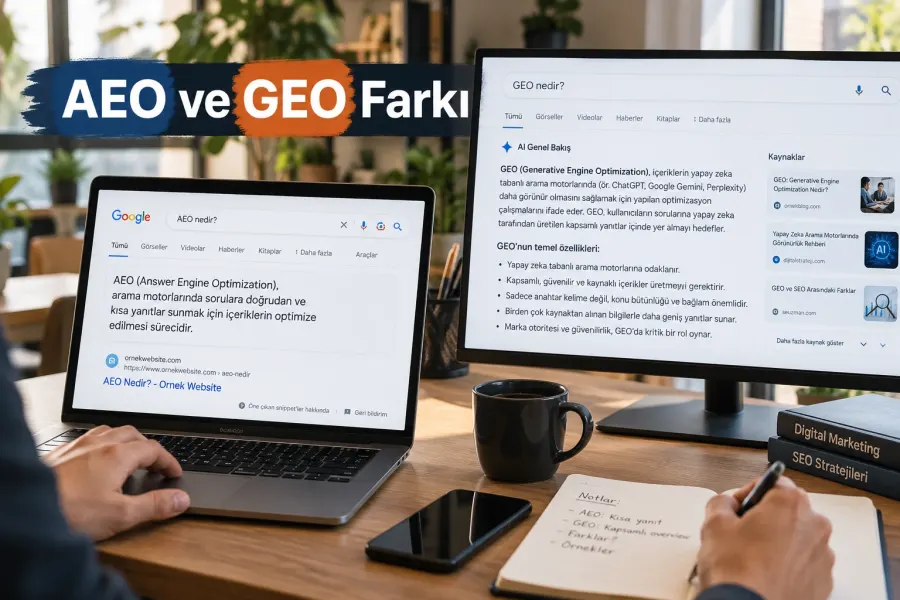
AEO focuses on the questions where users want a direct answer, while GEO relates more closely to the comprehensive answers generative AI systems build by bringing different information together.
LLM SEO, meanwhile, represents a more specific area of work aimed at improving how understandable content and brands are in systems running on large language models.
In this guide we examine the differences between AEO and GEO in detail, explain which approach matters for which kinds of search, and look at the methods you can apply to improve your website's visibility in AI-powered results.
We also assess why one real example that achieved visibility quickly through the right content changes may have worked, and how similar work can be planned.
What Is the Core Difference Between AEO and GEO?
The core difference between AEO and GEO lies in the type of answer being targeted and how the content is intended to be used.
AEO (Answer Engine Optimization) focuses on preparing content that answers users' specific questions clearly, accurately and as directly as possible.
GEO (Generative Engine Optimization) aims to prepare context-rich, explanatory content that generative AI systems can evaluate while building comprehensive answers.
To understand that difference, we can compare two different search queries.
The first user asks:
"What is compound interest?"
That question can be answered with a short, clear definition.
The second user asks:
"How does compound interest work, how does it affect savings over time, and why do different interest rates produce different outcomes?"
The second question is not just asking for a definition. It aims to learn how the subject works, what its effects are and how it can change under different conditions.
The first query is a good example for the direct-answer-focused AEO approach.
The second, because it requires far more comprehensive explanation, represents a content need that has to be considered from a GEO perspective.
That distinction is not a hard technical boundary, though. Generative AI systems can answer short questions too. In the same way, AEO principles can be used in specific sections of comprehensive content.
What matters is therefore not separating the two optimisation methods completely, but understanding which content format is more useful for which user questions.
How Does AEO Work? Direct-Answer-Focused Optimisation
AEO targets the situations where users want a fast, understandable answer to a specific question.
In this approach, organising content with clear headings, answering questions directly and presenting information in an easily understandable form all matter.
When a user searches for "what is a 301 redirect?", their first expectation is to learn what the concept means.
An AEO-friendly explanation for that question could be prepared like this:
"A 301 redirect is an HTTP status code announcing that a URL has moved permanently to another address. It is used to send browsers and supporting search engines to the new address."
That explanation answers the core question directly.
When 301 redirects are used, how they are implemented and what problems incorrect redirects can cause can then be explained in detail.
The important point for AEO is that the core answer does not get lost among long explanations.
Which Search Results Does AEO Target?
AEO work relates to the various search experiences where users can get a direct answer.
These can include search engines' featured answer areas, featured snippet results, certain information boxes and voice assistants.
When a user asks a voice assistant "how many metres are in a kilometre?", the system is not expected to read out a long article, for example.
Answering "a kilometre is a thousand metres" directly is more appropriate.
In the same way, the answers to certain questions can be shown in special information areas on Google, outside the standard organic results.
The aim of AEO work is to provide accurate, understandable information that can be used in experiences like those.
Using a particular content format does not mean the page will definitely be shown in a featured snippet or another answer area, however.
Why Do Long-Tail Keywords Matter for AEO?
Long-tail keywords are generally search queries expressing a more detailed and specific need.
"SEO" is a very general search phrase, for example.
"How do you do SEO for a newly launched e-commerce site?" is a far more specific question.
In that second query the user's need is far clearer.
Question-focused long-tail keywords can therefore be useful in AEO work.
By identifying the questions users genuinely ask, you can create suitable subheadings within your content.
Question headings should not be added purely to use a keyword, though.
Every question has to relate directly to the page's topic and the user's intent.
How Does GEO Work? Creating Content Suited to Generative AI Answers
GEO relates to the search experiences where AI systems build comprehensive answers.
A generative AI system can evaluate different information while answering the user's question and combine it into a new explanation.
In systems with web access, that process can involve examining more than one page and using the relevant information together.
When a user asks "which e-commerce platform is more suitable for beginners?", the answer may not consist of a single definition.
The features of different platforms, their cost structures, ease of use, integrations and the needs of businesses can all be evaluated together.
Depending on the tools it uses and the information it can reach, the AI system can draw on different content.
The aim of GEO optimisation is to support the information on a website being relevant and understandable in comprehensive evaluations of that kind.
Why Does GEO Require More Comprehensive Content?
From a GEO perspective, content consisting only of definitions may not be enough.
Explaining the problems, options and use cases users may encounter under different conditions is far more useful.
Consider an article prepared on the topic of "website prices".
If that piece only states that website prices vary by project, the user learns very little.
In more comprehensive content, the factors affecting prices can be explained.
Topics such as the number of pages on the site, design customisation, e-commerce features, multi-language support, integrations and maintenance services can all be addressed.
Why small businesses and larger organisations may have different needs can also be explained.
The content then helps not only with "how much do websites cost?" but with "which website suits me and how should I assess the costs?"
Contextual explanations of that kind can support generative AI systems in evaluating information related to far more detailed questions.
Why Does Original Information Matter for GEO?
There can be a great many similar explanations about the same topics on the internet.
Hundreds of websites may explain what SEO is, for example.
But the experience a business has gained from its own work, how it solved a particular problem, or the conditions under which it uses different methods, offers far more original information.
Presenting information of that kind clearly is valuable in a GEO strategy.
The aim here is not simply to look different from other websites.
It is to prepare genuinely useful, accurate information that contributes to the subject.
There is no guarantee that comprehensive, original content will be used by AI systems. But this approach does help your website become a more valuable source of information for users.
AEO and GEO Compared: Which Method Is Used for What?
To see the differences between AEO and GEO more clearly, we can compare the question types they target and their content approaches.
| Comparison | AEO | GEO |
|---|---|---|
| Core purpose | Providing a direct answer | Providing information that can be used in comprehensive AI answers |
| Question type | Specific, clear questions | Questions needing context, comparison and detail |
| Content format | Short answers, definitions, lists | In-depth explanations, examples, comparisons |
| Key element | Clarity of the answer | Scope and context of the information |
| Typical use | Featured snippets, answer boxes, voice assistants | Generative AI search, AI Overviews and comprehensive AI answers |
| Keyword approach | Specific question queries in particular | User intent and topical coherence |
| Page layout | Answering questions directly | Explaining topics from different angles |
| Success goal | Answer-focused visibility | Source or brand visibility in generative answers |
The differences in the table do not mean the methods are entirely separate.
An answer shown within Google AI Overviews can both answer a direct question and combine several pieces of information, for example.
Applying AEO and GEO principles together on the same content is therefore usually the more sensible approach.
Understanding the Difference Between AEO and GEO Through Search Examples
The distinction between AEO and GEO becomes easier to grasp through the questions users ask.
Example 1: Explaining a Technical Concept
AEO-focused question: "What is an SSL certificate?"
The core aim in that question is to learn what a concept means.
The content can begin by explaining directly what an SSL certificate is.
GEO-focused question: "Which operations does an SSL certificate protect on an e-commerce site, which security problems can it not solve on its own, and which other measures are needed?"
That query requires a far more comprehensive explanation.
The user wants to learn not just the definition but the applications and the limitations too.
Example 2: Choosing a Product
AEO-focused question: "What is MDF?"
The answer can explain the basic definition of MDF and how it is manufactured.
GEO-focused question: "What are the differences between MDF, solid wood and plywood for furniture to be used in a child's room?"
That question requires comparing material properties, conditions of use and different options.
Example 3: Digital Marketing
AEO-focused question: "What is organic traffic?"
The user's core need is an explanation of the concept.
GEO-focused question: "How can organic traffic be increased on a newly launched e-commerce site, and which SEO work should be prioritised?"
That question requires addressing several optimisation methods, prioritisation and implementation conditions.
What these examples have in common is the difference between a direct answer and a comprehensive explanation.
Both content types can sit in the same article, though.
How Does LLM SEO Differ from These Two Methods?
LLM SEO is an optimisation approach focused on content and brand visibility in AI applications running on large language models.
While GEO describes a broader generative search experience, LLM SEO is used for work specifically targeting systems that run on language models.
In this area, content coherence, level of expertise, clarity and the consistency of brand information all matter.
A business using certain keywords only on its product pages may not be doing enough to explain its area of expertise, for example.
Which industry the business operates in, which problems it can solve, which products or services it offers and which subjects it has experience in should all be explained clearly.
Becoming a Trustworthy Source of Information for LLM SEO
One of the long-term aims of LLM SEO work is for the business to become a brand that offers trustworthy, useful information in its field.
That goal is not achieved simply by publishing a large number of articles.
It takes real experience, accurate information and explanations that meet users' needs.
A business working in web design can share the technical experience it has gained from the projects it has built, for example.
A business specialising in e-commerce can explain the common problems encountered in product management and order processes.
A manufacturer can describe its products' material properties and conditions of use in detail.
Information like this makes a real contribution to the subject rather than repeating general internet explanations.
A brand being trustworthy does not mean it is recognised by every AI model or will be recommended in every answer, though.
The information AI systems can reach and the ways they build answers can differ.
How Do You Prepare a Single Piece of Content for AEO, GEO and LLM SEO?
To make a web page suit more than one optimisation aim, it is useful for the content to present information at different depths.
In this method the content can be planned across three core layers.
Layer One: The Direct Answer
First, the user's core question must be answered clearly.
Under the heading "What is an e-commerce site?", a short, accurate definition can be provided, for example.
That section is useful from an AEO perspective.
It also lets visitors new to the subject learn the basics quickly.
Layer Two: The Comprehensive Explanation
After the direct answer, how the subject works, its use cases and its effects under different conditions can be explained.
In the e-commerce site example, topics such as payment infrastructure, product management, shipping integrations, mobile use and security can be addressed.
That section builds a richer content structure from a GEO perspective.
Layer Three: Original Information and Experience
In the final stage, real implementation knowledge and expert explanations about the subject can be added.
The problems that can arise during an e-commerce development process can be described, for example.
Which features businesses should prioritise can be explained with examples.
Experience from real projects that is appropriate to share can be presented.
This layer helps the content become more than a piece that repeats basic information.
The same content can then create value both for users looking for a direct answer and for visitors wanting detail.
Why Does a Question-and-Answer Structure Matter in AI Search?
One method that can be used for both AEO and GEO work is organising certain sections of the content in a question-and-answer format.
That approach does not mean every subheading has to be a question, though.
What matters is that the questions users naturally ask get answered.
A heading such as "Website Performance" defines a general topic, for example.
"Why does my website load slowly?" represents a specific user question.
The core reasons can be explained immediately beneath that question.
Image sizes, server response times, JavaScript files and other technical elements can then be addressed in detail.
That structure can meet the needs of both visitors wanting a quick answer and people researching the subject in depth.
Do You Need to Add an FAQ Section to Every Article?
A frequently asked questions section can be useful on certain topics.
But a separate FAQ section is not compulsory in every article.
If a piece already answers users' core questions under suitable subheadings, repeating the same questions at the end is unnecessary.
What matters is that the content is organised, understandable and free of needless repetition.
Where FAQ sections are used, the questions must genuinely represent user needs.
Questions prepared purely to increase the keyword count reduce content quality.
How Is Structured Data Used for AEO and GEO?
Structured data is the technical markup method that helps define specific information on web pages in standard formats.
Markup prepared with the Schema.org vocabulary is widely used in this area.
Information such as the headline, author and publication date can be defined in an article, for example.
Fields such as price and stock status can be marked up appropriately on a product page.
There are also relevant structured data options for some content types containing questions and answers.
Using structured data does not mean search engines will definitely show the page in a special result format, however.
Adding FAQPage markup in particular does not mean every website will earn expanded question-and-answer results in Google.
How structured data is used by search engines depends on the supported features and the eligibility conditions.
There must also be consistency between the structured data and the real content the page shows visitors.
Can You Achieve Visibility in AI Results Very Quickly?
One of the most common questions about AI-powered search systems is how long content changes take to produce results.
In traditional SEO work, gaining visibility for specific queries can sometimes take a long time.
Content being discovered, indexed and shifting position within the competition all depend on various conditions.
In AI-powered search experiences, some content can be evaluated in current answers far sooner.
It should not be assumed that this applies to every website and every search, though.
It is possible for a page to be cited as a source in an AI answer shortly after being updated. But there is no guarantee that the same change will produce a similar result on another page.
An Example Where Visibility Was Achieved in About 12 Hours
In an example shared by an instructor selling online course content, a new campaign description is added to an existing sales page.
The page previously consisted of content listing the courses.
In the update, the special offer the instructor provides for users wanting to buy certain courses as a bundle is explained.
Information is also given about how the course discounts work, seasonal campaigns and the different purchase options.
The important point here is that the content targets a specific user question:
"Where can I find the biggest online course discounts?"
The instructor explains the conditions under which the bundle offer on his own site provides an advantage.
In the example shared, it is stated that compared with the roughly $10 course campaigns on the platform, the special offer works out at around $8 per course.
That information is far more explanatory than simply using a general phrase such as "discounted courses".
Because it helps the user understand how much they can save and why the offer is advantageous.
About 12 hours after the content update, a Google search shows some of the information from the page being used in the AI Overviews answer, with the website appearing among the source links.
That is a striking example of fast visibility following a content update.
The result is a single observation, though. It does not prove that the update alone caused that visibility.
Nor is there any guarantee the same outcome would repeat for other queries, for different users or on other dates.
What Conclusions Can Be Drawn from This Example?
There are a few notable points in this example.
First, the update relates directly to specific information the user was looking for.
Second, the page does not simply announce a campaign. It also explains how the campaign compares with the other purchase options.
Third, the advantage of the offer is described with specific conditions rather than general advertising phrases.
Finally, the new explanations were added to an existing web page already related to the subject.
This approach shows why original information that answers a specific question users are asking can be so useful.
Getting fast results in work like this is not a single automatic mechanism tied directly to content quality, though.
The website's existing visibility, the nature of the query, the competitive situation and the search system's access to current information can all affect the outcome.
How Do You Optimise Campaign Pages for GEO and AEO?
Campaign pages can be one of the suitable places to prepare content targeting specific user questions.
When a business publishes a page titled only "Big Discount", the scope of the campaign is not clear enough for visitors.
That page should explain which products are included in the campaign, the discount terms, the validity period and any limitations.
Which aspects set the campaign apart from the other purchase options can also be explained.
Example: A Website Service Package Campaign
Imagine a web design company has prepared a special package for newly founded businesses for a certain period.
This example is entirely hypothetical.
Rather than promoting the campaign only with the phrase "Special Offer for New Businesses", the company can prepare a detailed explanation.
The campaign page could answer these questions, for example:
- Which businesses is the campaign valid for?
- Which services are included in the package?
- How many pages does the website consist of?
- Is mobile compatibility included?
- Are domain and hosting services included in the package?
- What are the delivery time and revision terms?
- Between which dates is the campaign valid?
This information helps potential customers judge whether the offer suits them.
The content also gains a structure that answers specific questions directly.
When a campaign's advantages are presented with accurate, comparable and clear terms, it becomes far more valuable to the user.
The claims on the campaign page have to reflect reality, though.
Discounts that are not actually valid, misleading previous prices and advantages that do not exist must never be used.
How Do You Create Original Content for AI SEO?
Producing original content is one of the important shared areas of AEO, GEO and LLM SEO work.
Original content does not simply mean writing sentences that have not been used before, though.
An article containing unique phrasing does not necessarily mean the information it provides is different or useful.
Real originality is about preparing explanations that add value to the subject.
Draw on Your Own Experience
The experience a business gains during its day-to-day work can be used in content production.
A business working in web design can explain the website problems customers run into most often, for example.
A furniture maker can describe the differences certain materials make during production and in use.
An e-commerce business can examine which information in product descriptions helps reduce customer questions.
When this information is based on real implementation experience, it increases the value of the content.
Use Your Own Data Correctly
The real data a business holds can also be used to create original content.
The most frequently asked questions can be identified from customer support records, for example.
The general reasons behind product returns can be examined.
Measurements of website performance can be used to explain the effect of technical improvements.
The scope of the results obtained must be expressed accurately, though.
Presenting a result seen in a small group of customers as if it applied to the whole industry is wrong.
In the same way, unverified success rates, research that was never carried out and invented statistics must never be used.
Increase Explanatory Depth Instead of Repeating Other Content
Many articles may already have been written about a topic.
That does not mean new content on the same topic cannot be prepared.
But the piece you prepare has to provide the user with additional value.
In content titled "What Is SEO?", rather than offering only a definition, the implementation differences for specific types of business can be explained, for example.
Technical problems, common mistakes and real use cases can be addressed.
The content can then meet the reader's more detailed questions instead of simply presenting general information.
What Are Zero-Click Searches? How Do They Affect SEO Traffic?
A zero-click search is one where the user completes their search from the search results page without moving to another website.
That can happen for different reasons.
When a user searches for the weather, a simple calculation or a short definition, they can see the information they need directly on the results page, for example.
AI-generated answers can also reduce users' need to move to another web page for some queries.
This is an important change for website owners.
In traditional SEO work, a page's visibility is often evaluated through organic traffic.
In answer-focused search experiences, however, the user can reach certain information without visiting the business's website.
Are Zero-Click Searches Always Negative?
Zero-click searches can limit website traffic.
But if a brand's name or content is shown in the search results, that can contribute to brand awareness under some conditions.
Brand visibility and genuinely gaining visitors are not the same thing, though.
A user seeing a business's name in an AI answer does not mean they will become a customer.
The success of AEO and GEO work should therefore not be evaluated solely on whether visibility was achieved.
The relevant visitors reaching the website, real customer enquiries and the interactions that convert to sales all matter too.
Do AEO and GEO Work Replace Organic SEO?
AEO and GEO do not mean traditional SEO has disappeared entirely.
Users still examine websites in search engines, visit product pages and compare different sources.
In purchase decisions in particular, users' need to reach businesses' websites directly continues.
After getting a product recommendation from an AI tool, a person may visit the relevant website to check the price, stock status and sales terms.
In the same way, a user wanting to buy a service may want to review the business's references or quote terms on its own website.
Rather than treating SEO, AEO and GEO as competitors, it is therefore more useful to think of them as different visibility opportunities.
Traditional SEO helps users find your website, while AEO and GEO support your information being evaluated in different answer and search experiences.
Common Mistakes in AEO and GEO Optimisation
In AI-focused visibility work, some wrong approaches can harm both content quality and the user experience.
Turning Every Heading into a Question
Question-format headings are useful for meeting specific user needs.
But forcing every heading into a question disrupts the natural flow of the article.
Explanatory, topic-focused headings need to be there too.
What matters is that question-format headings genuinely provide the answer to the question.
Preparing Only Short Answers
Short, direct answers matter for AEO.
But an article consisting only of definitions a few sentences long is inadequate for users looking for detail.
The necessary explanations should therefore follow the core definitions.
Treating Long Content as Automatically High Quality
An article being long does not mean it is necessarily good.
Repeating the same information in different sentences creates no real depth in the content.
What matters for GEO is not word count but the presence of meaningful information that meets the user's question.
Creating Misleading Information for AI
It is wrong for a brand to describe features it does not actually have in order to be recommended more often.
A business presenting itself as the industry leader without verification is not the same as providing real, comparable information, for example.
Every claim used in content must be as clear, accurate and, where necessary, verifiable as possible.
Presenting Fast Results as a Guarantee
One web page becoming visible in AI results quickly does not mean every business will see results in the same time.
Crawl processes, search queries, competition and the systems in use can all differ.
Phrases such as "guaranteed AI recommendation in 12 hours" therefore do not represent a trustworthy SEO approach.
How Do You Measure the Success of AEO and GEO Work?
To evaluate the impact of AEO and GEO optimisation, several measurements need to be examined together.
First, you can check how the questions you are targeting are being answered in search engines.
Whether the relevant page appears in answer areas such as featured snippets can be examined.
Which content is cited as a source in queries with Google AI Overviews can be observed.
Using different question formats in AI-powered search tools, you can assess which subjects the business is associated with.
These checks have their limits, though.
An AI tool's answer can change with the user, the location, the time or how the query is worded.
The result obtained from a single query should therefore never be seen as lasting, general ranking success.
Evaluate Visibility and Traffic Together
When content is cited as a source in an AI answer, brand visibility can be gained.
But that visibility does not always turn into a website visit.
Organic traffic, the performance of the relevant pages and customer interactions can therefore be evaluated together.
A newly prepared service page may have gained search visibility, for example.
But if no customer enquiries about the service are coming in, the page's alignment with user intent or the offer it presents should be examined separately.
A successful strategy should aim not only at gaining more impressions but at producing results connected to the business's goals.
A Practical Content Optimisation Plan for AEO and GEO
A business can follow a systematic plan to start AEO and GEO work on its existing website.
1. Identify the User Questions You Are Targeting
First, research which questions your target audience asks.
Some of those questions will be short and direct.
Others will require comparison, recommendation or detailed explanation.
Separating the questions this way helps determine how the content should be structured.
2. Examine Your Existing Content
Before preparing new articles, evaluate the content already on your website.
Some pages may already contain comprehensive information.
Adding the missing explanations or direct answers to those pages is often more appropriate than creating an entirely new page.
3. Improve the Direct Answers
Clear definitions should be prepared for specific questions.
There must be a direct relationship between the heading and the answer.
Unnecessary introductory sentences should be reduced and the user's core question met.
4. Broaden the Content's Context
After the core explanations, use cases, comparisons and outcomes under different conditions should be described.
The content then serves not only short answers but more comprehensive information needs too.
5. Add Original Information
The business's real experience and the explanations it can contribute to the subject should be considered.
Properly prepared data and implementation examples can be used where available.
Unverified numerical claims must never be created, however.
6. Check Technical Accessibility
It matters that the content you prepare is discoverable by search engines.
Internal links to important pages can be added.
Check that the pages work correctly, that there are no access blocks, and that the content is technically understandable.
7. Review the Search Results
After content changes, the queries you are targeting can be re-evaluated at regular intervals.
How the page or the brand is represented across different answer systems can be examined.
The missing explanations identified through those reviews can then be developed.
How Do You Build a Long-Term Strategy for AEO, GEO and LLM SEO?
Gaining visibility quickly can be appealing from a digital marketing standpoint.
But sustainable results require long-term improvement in content quality.
A business becoming a trustworthy source of information on a particular subject is not a simple goal achievable with a single article.
Addressing the subjects related to the business's field in a planned way is useful.
A business working in web design can prepare genuinely helpful guides on site performance, user experience, security and content management, for example.
Every topic does not have to be covered in the same article, though.
Each piece of content can focus on one specific user need.
Meaningful links can be built between pages that complement each other.
Explanations that have become outdated can be revised.
The business's real experience can be worked into new content.
This approach supports short-term optimisation work with a far broader content strategy.
Create Value for Users, Not for AI
One of the most important points about AI optimisation is that content must not be prepared purely to influence automated systems.
A page answering specific questions matters.
But those answers have to be accurate, understandable and useful to the user.
In the same way, sections unrelated to the subject must not be created purely to add different keywords while preparing a comprehensive article.
The length and organisation of content should be determined by what the subject requires.
Real expertise and explanatory information carry value not only for AI systems but for the business's potential customers.
The Most Common Questions About AEO and GEO
Which Is More Important, AEO or GEO?
There is no single answer to that question that applies to every website. On subjects where users are looking for a direct answer, the AEO approach comes to the fore. For detailed comparisons and questions needing context, providing comprehensive information from a GEO perspective is useful. Most websites can consider both approaches together.
Is Writing Long Articles Compulsory for GEO Optimisation?
No. There is no required word count for GEO. The length of the content should be determined by the user's information needs. Some subjects can be covered with short explanations, while comprehensive comparisons require longer content.
Is an FAQ Section Necessary for AEO?
No. FAQ sections can be useful on some pages but are not compulsory. The user's question can be answered directly under a suitable subheading. The same information should not be repeated unnecessarily.
Is Fast Visibility in AI Results Possible?
In some cases visibility can be observed shortly after content updates. But those results do not apply to every website. Factors such as how the search system works, the nature of the query and the website's current state can all affect the outcome.
Do You Need to Prepare Separate Content for Every Platform for AI SEO?
Generally no. Comprehensive, understandable content that answers users' questions correctly is useful across different search systems. The platforms' access methods and answer-generation processes can differ, though.
Should Traditional SEO Work Be Abandoned?
No. Traditional SEO is still important for websites being discovered in search engines and gaining organic visibility. AEO and GEO should be seen as approaches that complement that work.
Conclusion: Why Does Understanding the Difference Between AEO and GEO Matter?
Understanding the difference between AEO and GEO is an important starting point for businesses that want to prepare content suited to AI-powered search experiences.
AEO aims to provide direct, understandable answers to users' specific questions.
GEO focuses on preparing context-rich, explanatory information that can be used in generative AI systems' comprehensive answers.
LLM SEO describes the work aimed at improving brand and content visibility specifically in systems running on large language models.
Although these approaches have different goals, there are important points in common between their methods.
Question-format headings, direct answers, comprehensive explanations, real experience and original information can all be used together.
Examples where visibility was achieved quickly in AI-powered search systems show the potential of explanatory content aimed at a genuine user need.
Results like that may not happen at the same speed or in the same way for every business, though.
Rather than aiming only to be visible in certain AI queries, supporting your website in becoming a trustworthy and valuable source of information over the long term is therefore a far stronger approach.
At the heart of a successful AI SEO strategy lies not merely appearing in search results, but answering users' questions accurately, explaining subjects comprehensively and offering real informational value that cannot easily be found elsewhere.
This approach preserves traditional SEO work while helping you develop digital visibility within a far wider frame through AEO, GEO and LLM SEO methods.