














How to Do AI SEO: A GEO, AEO and LLM SEO Guide
How do you do AI SEO? We walk through optimising a single web page for SEO, AEO, GEO and LLM SEO step by step, where AI gets its information about your business, about-page optimisation, topical authority and Google AI Overviews visibility.
For businesses that want to be visible in search engines, SEO has been one of the fundamental elements of digital marketing for many years. But as AI-powered search systems have spread, simply appearing in traditional search results has stopped being a sufficient goal for websites.
Today, as well as searching on Google, users put questions directly to AI tools such as ChatGPT, Gemini, Claude and Perplexity. They compare products, research service providers, learn about businesses and ask for recommendations to support their purchase decisions.
That shift raises an important question for website owners: how can a website become more visible both in Google search results and in AI-powered answer systems?
The answer lies in evaluating traditional SEO work alongside the GEO, AEO and LLM SEO approaches.
You do not need to create entirely separate web pages for each of these optimisation methods, though. A well-structured, comprehensive and trustworthy piece of content can serve several optimisation aims at once.
In this guide we cover in detail how to do AI SEO work, how a web page can be prepared for different search systems, where AI gets its information about businesses, and the content strategies that support Google AI Overviews visibility.
What Is AI SEO and How Does It Work?
AI SEO refers to the optimisation work carried out to help websites and digital content be more understandable and visible in AI-powered search, answer-generation and information-evaluation systems.
This approach has a great deal in common with traditional search engine optimisation. But instead of only ranking content for specific keywords, it also emphasises preparing content that can answer users' detailed questions.
In classic SEO work the keyword "corporate website" might be targeted, for example. The page title, descriptions and content are organised in relation to that search phrase.
In an AI-focused approach, users' more detailed questions are considered too.
A user might ask an AI:
"I want a professional website for the business I have just set up. Would a five-page site be enough, which features should it have, and what should I watch out for?"
That query contains more than a keyword about website design. The user's business situation, needs, budget-related expectations and decision-making process are all present.
A relevant web page containing only the phrase "corporate website design" may therefore not be enough.
The page also has to explain the different types of website, the use cases, the service scopes and the things users need to weigh up when deciding.
The core aim of AI SEO work is making content better suited to detailed information needs of that kind.
How Are SEO, AEO, GEO and LLM SEO Used Together?
Although traditional SEO, AEO, GEO and LLM SEO focus on different visibility aims, their implementations largely complement each other.
Comparing these approaches makes it easier to understand what to pay attention to when preparing content.
| Method | Target area | Content approach |
|---|---|---|
| SEO | Organic results in search engines such as Google and Bing | Keywords, search intent, technical optimisation and content quality |
| AEO | Direct answer systems, featured results and voice assistants | Clear questions, short answers, organised information structure |
| GEO | AI-powered search and answer experiences | Context, comprehensive explanations, original information and coherence |
| LLM SEO | AI applications running on large language models | Expertise, brand identity, trustworthiness and understandable information |
Rather than thinking of the methods in this table as independent tasks, it is more useful to treat them as different improvements you can apply to a single piece of content.
In a comprehensive guide about corporate website design, keywords can be used naturally, for example.
In the same content, the question "what is a corporate website?" can be answered directly.
Which types of website different businesses may need can be explained in detail.
Finally, the content can be supported with real expertise and practical knowledge.
A single page can therefore offer the characteristics targeted by different optimisation approaches all at once.
How Do You Optimise a Single Web Page for SEO, AEO, GEO and LLM SEO?
To make a web page suit different search and AI systems, the content structure has to be built deliberately.
To make the process concrete, let us work through an example piece titled "What Is a Corporate Website and How Is One Built?"
That is a subject people can research in traditional search engines and also put to AI systems as detailed questions.
Step 1: Determine the Keyword and Search Intent
The first step is determining which user need the content will address.
Content should not focus only on a keyword with high search volume. What the user wants to learn, compare or buy also has to be understood.
There can be different search intents around the subject "corporate website", for example.
A user wanting information may research what a corporate website is.
Another user approaching the purchase stage may want to learn corporate website prices.
A user comparing two different services may be curious about the differences between an off-the-shelf website and a custom-designed one.
Even though these queries relate to the same subject, they represent different information needs.
Rather than answering each question superficially in a single paragraph, you therefore need to set a scope suited to the content's purpose.
The page's main heading should reflect the user's core search intent.
The subheadings should explain the related questions and subtopics in an organised way.
Step 2: Prepare Direct Answers for AEO
In AEO optimisation, providing clear answers to user questions matters.
Question-format subheadings can therefore be used within the content.
For example:
What is a corporate website?
A corporate website is a website built to present a business's services, products, contact details and corporate identity online. Depending on the business's field of activity, it can contain different pages, contact forms, service descriptions and various functions.
That explanation answers the question directly.
You can then move on to the details.
Which pages does a corporate website consist of?
A corporate website generally has a homepage, an about page, service pages and a contact page. Depending on the business's needs, project, reference, blog or product pages can be added too.
This method lets users reach the core information they are looking for quickly.
What matters for AEO is not only using question headings. The explanation immediately beneath the heading has to genuinely answer the question.
Rather than delaying the answer with unnecessary introductory sentences, give the core information first, then the necessary detail.
The Characteristics of AEO-Friendly Paragraphs
Paragraphs written to provide a direct answer are best kept short and clear.
Answers of roughly 40 to 80 words work well for many definitions and basic explanations. That range is not a compulsory SEO rule, though.
Some questions can be answered in a single sentence while others require far more detail.
What matters is that the correct answer does not get lost among unnecessary phrasing.
Lists and comparison tables can also be used where several items need explaining.
The reader can then find the information they need easily.
Step 3: Broaden the Content's Context for GEO
In GEO optimisation it matters not only that the content provides the basics, but that it explains the subject across different conditions of use.
In content about corporate websites, describing only the standard page types may not be enough, for example.
The fact that different businesses have different needs should be explained too.
For a consultancy firm, service descriptions, areas of expertise and contact details may come first.
For a furniture maker, product catalogues, material information, dimensions and project images may matter more.
For a restaurant, the menu, location, opening hours and reservation options may be more decisive.
Examples like these connect the subject to different scenarios.
When an AI-powered search system encounters a question that includes a user's industry or need, contextual explanations of that kind can help the relevant information be evaluated.
How Do You Create Semantic Richness?
Semantic richness is explaining a subject through related concepts and subtopics.
In content about corporate website design, subjects such as mobile compatibility, user experience, hosting, domain names, SSL certificates, page speed and content management can all be addressed.
Simply listing those concepts is not enough, though.
Each concept's relationship to the main subject has to be explained.
How mobile compatibility affects the usage experience at different screen sizes can be described, for example.
The role of an SSL certificate in connection security can be explained.
The effect of page performance on the user experience can be assessed.
The content then forms a meaningful information structure rather than a set of disconnected keywords.
Step 4: Add Expertise and Original Information for LLM SEO
In LLM SEO work, a piece of content's level of expertise and the original information it provides both matter.
There can be a great deal of content about similar subjects on the internet. But not all of it has the same level of detail, practical knowledge or quality of explanation.
Rather than repeating the general information found on other pages, a piece should therefore aim to provide useful explanations specific to the subject.
A web design specialist can explain the common problems encountered in the projects they have built for different businesses, for example.
They can describe the technical requirements small businesses often overlook when building a website.
They can compare the advantages and limitations of different design methods.
Experience from real projects that is appropriate to share can be included in the content.
This approach matters not only for AI systems but for visitors considering buying a service.
Claims of expertise have to rest on real knowledge and experience.
A business must never present projects it has not carried out as completed, use unverifiable success rates, or convey experience it does not have.
Real, understandable information builds a far more trustworthy foundation than exaggerated marketing phrases.
Step 5: Support the Content with Images, Tables and Examples
Comprehensive content does not have to consist only of long paragraphs.
Depending on the subject, images, explanatory tables, process diagrams and real implementation examples can all be used.
In a piece about website design, a comparison of mobile and desktop views can be presented, for example.
In content about an e-commerce site, the order process can be explained step by step.
In a technical guide, suitable screenshots of the application can be used.
These elements can help users understand the subject more easily.
Images must not be added purely to fill the page, though. Every image has to relate directly to the subject being discussed.
Supporting images with explanatory alt text, and making sure they do not needlessly harm page performance, matters too.
How Do AI Tools Get Information About a Business?
One of the important parts of LLM SEO work is understanding what information AI systems hold about a brand or business.
When a user asks an AI system about a particular business, the system can build an answer from the information it holds and the tools it can use.
Those answers may not always be complete or current.
A business's old services, outdated descriptions or incorrect information can appear in some answers.
Before starting AI optimisation, it is therefore useful to examine the brand's current digital visibility.
What Does AI Know About My Brand?
Start by examining how the brand is described across different AI tools.
These questions can be used for that:
- What information do you have about my business?
- Which services does my business offer?
- Which industry does my brand operate in?
- What sets my business apart from similar firms?
- Which sources can you verify the information you gave about my business against?
The answers to these questions should be examined carefully.
If the business is being described with a service it no longer offers, note that down, for example.
If its field of activity is stated incorrectly, establish the correct description.
If the brand's important services are never mentioned, check whether those services are explained clearly enough on the website.
An AI's answer does not always show definitively which source the information came from, though.
A system can draw on its model knowledge, the web pages it can reach at that moment, or various information-retrieval methods.
When an incorrect statement about the business is detected, the source of the problem should therefore not be identified with certainty from the AI's answer alone.
How Do You Identify Old Brand Information?
Incorrect or outdated statements presented by an AI can be researched separately in search engines.
If a service description the business used previously appears in the AI's answer, the same phrase can be queried in a search engine, for example.
You can then research which web pages still contain that old information.
Useful areas to check include the business's homepage, about page, service pages and old promotional content.
The same brand being described contradictorily on different pages creates uncertainty for users too.
Identifying outdated information and correcting it on the necessary pages therefore matters.
Why Does the About Page Matter for LLM SEO?
A website's about page is one of the core areas describing the business's identity.
That page usually covers the brand's history, fields of activity, expertise and working approach.
In traditional SEO work, the about page has not always been treated as a priority traffic source.
But that page has long had an important function in letting visitors learn about the business and build trust.
From an LLM SEO and GEO perspective, the about page providing understandable information is useful too.
An AI-powered system researching brand information on the web can reach that page.
Having clear, current information there can support the business being described correctly.
Optimising the about page does not mean AI systems will definitely recommend the brand, though.
How Do You Prepare an AI-Friendly About Page?
A well-prepared about page should not consist only of the business's founding story.
The page's core purpose is letting the visitor understand the business clearly.
The first section should therefore state the business's name, field of activity and the core services it offers.
Which customer groups the business serves can then be described.
Real areas of expertise, working processes and any verifiable experience can be included.
A business offering web design services should not settle for describing itself only as a "professional team delivering innovative digital solutions", for example.
It can instead explain which types of website it builds, which industries it serves and what working process it applies for its customers.
That information is far more meaningful both for people and for automated information-processing systems.
Which Information Should an About Page Contain?
When preparing an about page, these areas can be considered:
- The business's identity: the brand name and core field of activity.
- The services offered: the products or services the business genuinely provides.
- The target audience: which industries or customer groups it serves.
- Areas of expertise: which subjects the business has knowledge and experience in.
- Working approach: how the services are planned and carried out.
- Real experience: verifiable projects, work and achievements.
- Contact details: the current channels visitors can use to reach the business.
This information should be explained under logical headings rather than placed at random.
Achievements the business does not have and unverified numerical data must never be used.
What matters is not writing a long piece of self-praise but describing accurately what the brand actually does.
Is Updating the About Page Enough for AI?
Updating the about page is an important step, but it does not solve every AI visibility problem on its own.
If a business describes its activities one way on the homepage, another way on the service pages and a third way on the about page, uncertainty about the brand continues.
Core brand information therefore has to be consistent across the different sections of the website.
If the business now designs e-commerce sites only but old pages state that it offers general software development services, those statements should be reviewed against the current service scope, for example.
In the same way, the business's contact details and the services it offers must be kept current.
How Do You Show AI Your Current Information?
You can give an AI tool the link to your business's current about page and ask it to examine the information there.
Where the tool can reach the link, it can then evaluate that information within the current conversation.
You can then ask it to describe the business again and check whether it understood the information on the current page correctly.
There is an important distinction here, though.
An AI tool reading your current page in one conversation does not mean the model's general knowledge has permanently changed.
There is no guarantee that other users will immediately get the same up-to-date answers about the business.
When web pages will be rediscovered or re-evaluated by different systems is also uncertain.
The right approach is therefore to update the information on your website and re-examine visibility across different AI systems over time.
The Contact Page and the Consistency of Brand Information
In LLM SEO work, the contact page should be assessed alongside the about page.
The contact page presents the business's real communication channels and operating information.
Contact details on a website being out of date harms not only AI visibility but the customer experience directly.
If the business's old email address appears on different pages, customers can use the wrong channel, for example.
Old addresses or changed service area information cause problems in the same way.
It is therefore useful for the business's name, communication channels and core descriptive information to be consistent across the whole website.
Clear brand information supports potential customers' trust while also making information about the business easier to understand.
What Is Google AI Overviews?
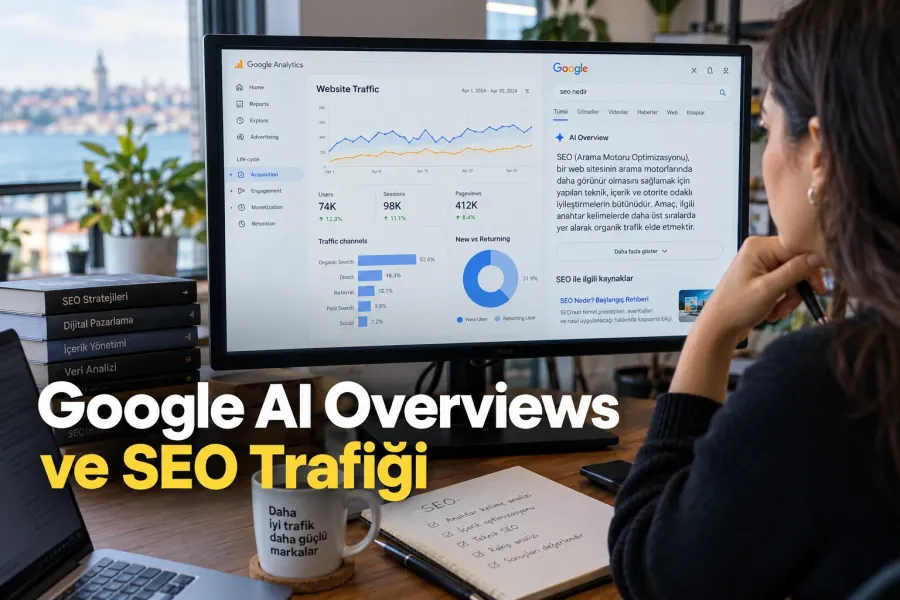
Google AI Overviews is a feature that shows AI-generated summary answers in Google search results for certain queries.
Those answers can include explanations about the subject the user asked about, comparisons and links to related web pages.
Google does not present answers of this kind the same way for every query. How the feature appears and which queries it shows up for can vary.
AI Overviews is part of the search experience Google has developed with its generative AI features.
The name Search Generative Experience (SGE), which Google used during development, also relates to this subject.
SGE was the name used in the earlier development stages of the generative AI-powered search experience. AI Overviews is the product name used for the AI summaries presented in Google search results.
Why Does Google AI Overviews Matter for SEO?
In traditional Google search results, users generally click links after reviewing web pages' titles and descriptions.
In a search experience with AI Overviews, however, the user can see some information directly on the results page.
That creates both new visibility opportunities and new challenges for websites.
Content being cited as a source within AI Overviews can let a business appear in a different search area.
But if the user finds the answer they were looking for directly on Google, they may not need to click through to the website.
When assessing AI Overviews visibility, you therefore need to consider not only visitor numbers but brand visibility and how the user is reaching information.
How Do You Become Visible in Google AI Overviews Results?
There is no guaranteed method for getting a website cited as a source in Google AI Overviews results.
That said, preparing high-quality, accessible and relevant content matters.
A website providing comprehensive information on a particular subject, pages being linked together logically, and user questions being answered clearly all build a useful foundation.
Within that work, the approach known as topical authority holds an important place.
What Is Topical Authority?
Topical authority is a content strategy concept about a website providing comprehensive, consistent and useful information in a particular subject area.
There can be a difference in content scope between a site that mentions website design in one blog post and a site that prepares comprehensive guides on web design for different needs, for example.
The second site can explain everything from choosing a domain name to page performance, with each topic complementing the others.
That helps the website build a far more comprehensive information resource in a particular subject area.
Topical authority is not a Google score earned automatically once a certain number of articles is published, though.
The content has to be genuinely useful, suited to the subject and free of needless repetition.
Why Does Building Topic Clusters Matter?
Topic clusters rest on the principle of supporting a main subject with subtopics that complement each other.
A business working in web design can address the subject of building a website in a core guide, for example.
The content supporting that guide can explain domain name choice, hosting, mobile compatibility, SSL certificates, page speed, user experience and website maintenance processes.
Relevant information is then provided for different user questions.
Preparing dozens of very similar articles provides no benefit on its own, though.
Rather than creating pages with only the headings changed and largely identical content, each page should aim to answer a different user need.
That approach makes it easier for users to navigate the site while strengthening the semantic relationships between topics.
How Should Internal Links Be Used?
Internal links are one of the important parts of topic clusters.
When an article touches on a different subject, you can link to the page that explains that subject in detail.
If a piece about website design explains the importance of SSL certificates, a link can be added to a separate guide about SSL setup, for example.
That link makes it easier for the reader to reach the additional information they need.
It also builds a logical relationship between the related content on the website.
Internal links must not be added at random purely for SEO, though.
There has to be a genuine relationship between the section containing the link and the subject of the target page.
Is Publishing Content Regularly Necessary for AI SEO?
Producing content regularly can help a website broaden its body of knowledge on particular subjects.
But publishing articles at set intervals does not automatically lift you up the rankings in search engines or AI results.
What matters is less the number of pieces than how well they meet users' needs.
Rather than publishing five superficial pieces a week, preparing content that explains a particular subject comprehensively and provides genuinely useful information is far more valuable.
How current your existing content is matters too.
Technical features, product models, service scopes and implementation methods can all change over time.
Old articles should therefore be reviewed, incorrect information corrected and new explanations added where needed.
Content updating work can be just as important as creating new pieces.
Author Information and Expertise Statements for LLM SEO
It being clear who prepared an article is useful, especially on subjects requiring expertise.
Author information can help readers assess which experience or body of knowledge the explanations in the content rest on.
If the author of a technical article about web design has web development experience, that information can be stated in the content, for example.
Adding the same long biography to every article is not necessary, though.
Explaining the author's experience of the subject briefly and accurately can be enough.
If a piece relates directly to the business's area of expertise, the business's working experience can also be described appropriately.
The core aim here is making it easier for the reader to assess the credibility of the information presented.
Why Is Original Experience Valuable?
General definitions can often be found in similar form on different websites.
Real implementation experience, by contrast, can give content a distinctive value.
The performance problems encountered on web design projects can be described through real implementation conditions, for example.
An e-commerce business can explain the difficulties encountered in managing product catalogues.
A furniture maker can share production experience of where different wood materials are used.
Information like this provides real detail about the implementation process rather than only theoretical explanation.
The content can then become far more comprehensive and far more useful to the user.
What Should Content Structure Look Like for AI SEO?
Organising the information on a web page logically is useful for both visitors and automated systems.
There should be a clear flow from the content's heading through to its conclusion.
A structure you can generally use can be planned like this:
- Main heading: states the content's core subject clearly.
- Introduction: explains which question will be answered.
- Direct answer: provides a short, clear explanation of the core concept or question.
- Detailed explanations: address the subtopics, use cases and important details.
- Comparisons: show the advantages and limitations of different options where needed.
- Implementation examples: explain how the information is used in real or clearly labelled example scenarios.
- Conclusion: summarises the core points and helps the user decide.
This structure does not have to be applied exactly in every article.
Different arrangements can be made depending on the subject, the audience and the search intent.
What matters is that there is a logical connection between the headings and the explanations.
What Does Structured Data Provide for AI SEO?
Structured data allows the information on web pages to be defined in specific technical formats.
That method can make it easier for supporting search engines and other automated systems to identify certain information on the page.
Fields such as author, publication date and headline can be marked up for an article, for example.
On a product page, the product name, price and stock information can be stated with the suitable markup types.
A business's core information can also be supported with the relevant structured data formats.
What matters in these implementations is that the data used is consistent with the page's real content.
Adding structured data does not on its own guarantee AI Overviews visibility or recommendation by large language models.
Nor should it be assumed that every AI system uses structured data the same way.
Structured data should therefore be treated as one of the supporting technical elements of a comprehensive SEO strategy.
Common Mistakes Made in AI SEO Work
In next-generation search optimisation work, some practices do not deliver the benefit expected.
Chief among them is preparing content purely to influence AI systems.
A web page should be useful to real users first and foremost.
Adding unnecessary keywords, repeating the same information or preparing explanations unrelated to the subject in the belief that AI tools will pick up certain phrases reduces content quality.
Another mistake is using unverifiable achievements to create an impression of expertise.
Describing services the business does not actually offer, or stating experience it does not have, harms credibility.
Rather than producing a large number of short, very similar articles, content should be planned around user needs.
Treating the answers you get from AI systems as definitive results is also wrong.
One tool describing the brand correctly does not mean every other system holds the same information.
Visibility assessments should therefore be repeated with different queries and at regular intervals.
How Do You Measure AI SEO Performance?
In traditional SEO work, measurements such as organic traffic, keyword rankings, impressions and clicks are used.
In AI SEO work, assessing visibility can require a far broader perspective.
Which questions a brand is mentioned in connection with across AI-powered systems can be examined.
Whether the business is being described with the correct services can be checked.
The accuracy of the links and source citations AI systems provide can be assessed.
Carrying out these reviews with a single question is not enough, though.
For a business offering web design services, questions representing different user intents can be prepared, for example:
- "What should you watch out for when building a corporate website?"
- "Which type of website is suitable for small businesses?"
- "Why does a mobile-friendly website matter?"
How questions of this kind are answered across different AI systems can be examined.
During that review, rather than looking only at whether the business name appears, check whether the information given is accurate.
Remember too that AI systems' answers can change over time, by user and by tool.
Test results should therefore be treated not as definitive rankings but as observations that help you understand your current visibility.
A Practical AI SEO Checklist for Businesses
Businesses that want to start AI-focused visibility work can begin by assessing the state of their existing website.
During that assessment, look for answers to these questions:
- Does the website explain the business's field of activity clearly?
- Does the about page contain current, accurate information?
- Do the service pages answer users' core questions?
- Does the content explain the use cases for the products or services?
- Do the blog posts address subjects that complement each other?
- Is there outdated information on the website?
- Are the important pages usable on mobile devices?
- Are the pages' heading structure and content layout understandable?
- Are subjects requiring expertise supported with real knowledge and experience?
- Is how the business is described in AI tools being checked?
These questions can help prioritise the work to be done.
If the business's about page is empty or its core field of activity is described incorrectly, fixing those gaps first makes sense, for example.
If the service pages consist only of short promotional sentences, explanations that answer users' questions can be added.
If the blog content focuses on disconnected subjects, a content plan related to the business's area of expertise can be prepared.
SEO, GEO, AEO and LLM SEO work can then be applied according to the business's real needs rather than carried out piecemeal and without a plan.
How Long Does AI SEO Work Take to Produce Results?
There is no definite timeframe for AI SEO work that applies to every website.
As with traditional search engines, content being discovered, evaluated and becoming visible on different platforms depends on various conditions.
The website's current state, content quality, subject area, competitive conditions and how the systems in use work can all affect the outcome.
An AI system being able to reach current web pages and a language model building answers from previously acquired knowledge are also not the same process.
You should therefore not expect every AI tool to use new information immediately after a web page is updated.
Some changes can be evaluated in tools' live web operations, while other systems may use updated information later or not at all.
AI SEO work should therefore be treated not as a set of tasks delivering definite results quickly, but as a process requiring regular improvement and assessment.
Should AI SEO and Traditional SEO Run Together?
The development of AI-powered search experiences does not mean traditional SEO work should be abandoned.
Websites being discoverable by search engines, pages working properly and content being prepared to suit user needs all still matter.
Some AI-powered search systems also use search and content-retrieval infrastructure to reach information on the web.
There is therefore a strong relationship between traditional SEO and the newer optimisation approaches.
For a website with technical problems, content that is hard to understand or incorrect information, adding a few AI-focused explanations will not be enough.
The website's basic structure has to be sound first.
The content can then be developed to meet users' more detailed questions.
In other words, AI SEO is not a method that sweeps away all the rules of traditional SEO.
It is an approach that extends existing optimisation work to suit changing search habits.
Conclusion: What Is the Right Strategy for AI SEO?
The spread of AI-powered search systems is changing how businesses assess their digital visibility.
Traditional SEO work supports websites appearing in organic search results, while approaches such as AEO, GEO and LLM SEO focus on preparing content to suit different answer and information-evaluation systems.
One of the most important points in that process is that a website should not be built around specific keywords alone.
Content has to answer users' real questions, explain subjects across different conditions of use and provide trustworthy information.
Keeping the about page current, describing the business's field of activity accurately, presenting expertise clearly and building meaningful links between related subjects are all important parts of that strategy.
For businesses aiming for visibility in AI-powered search features such as Google AI Overviews, topic scope and content quality should be considered too.
No optimisation method can guarantee that a brand will definitely be recommended or cited as a source in particular AI systems, however.
A successful approach should therefore rest on improving the website's overall information quality and the value it offers the user, rather than targeting the short-term behaviour of one specific search system.
A strong SEO strategy in the age of AI means building a website that, alongside using the right keywords, answers users' questions clearly, sets out its expertise understandably and provides genuinely useful information on a particular subject.